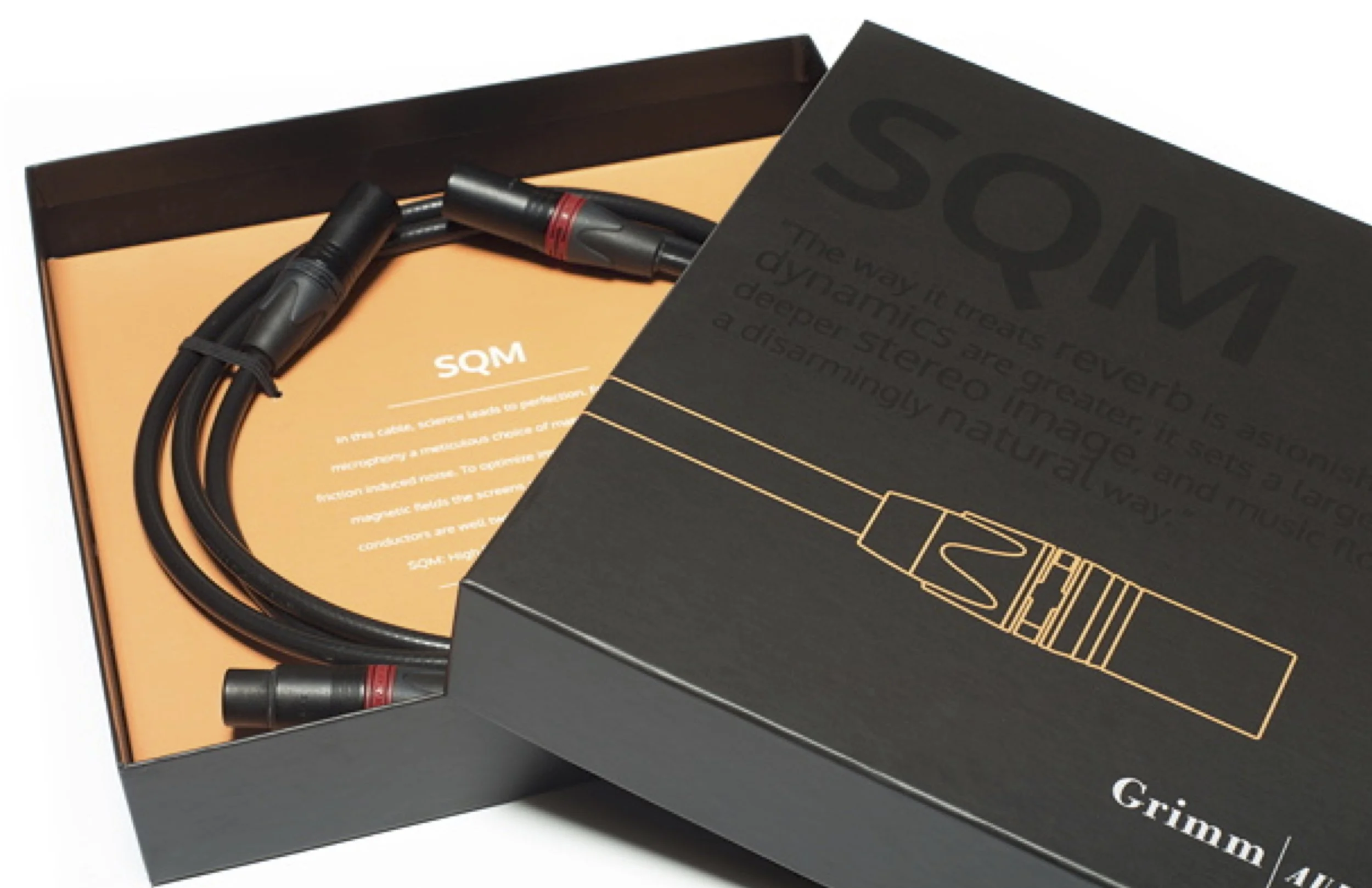
GRIMM AUDIO SQM CABLES - REVIEW
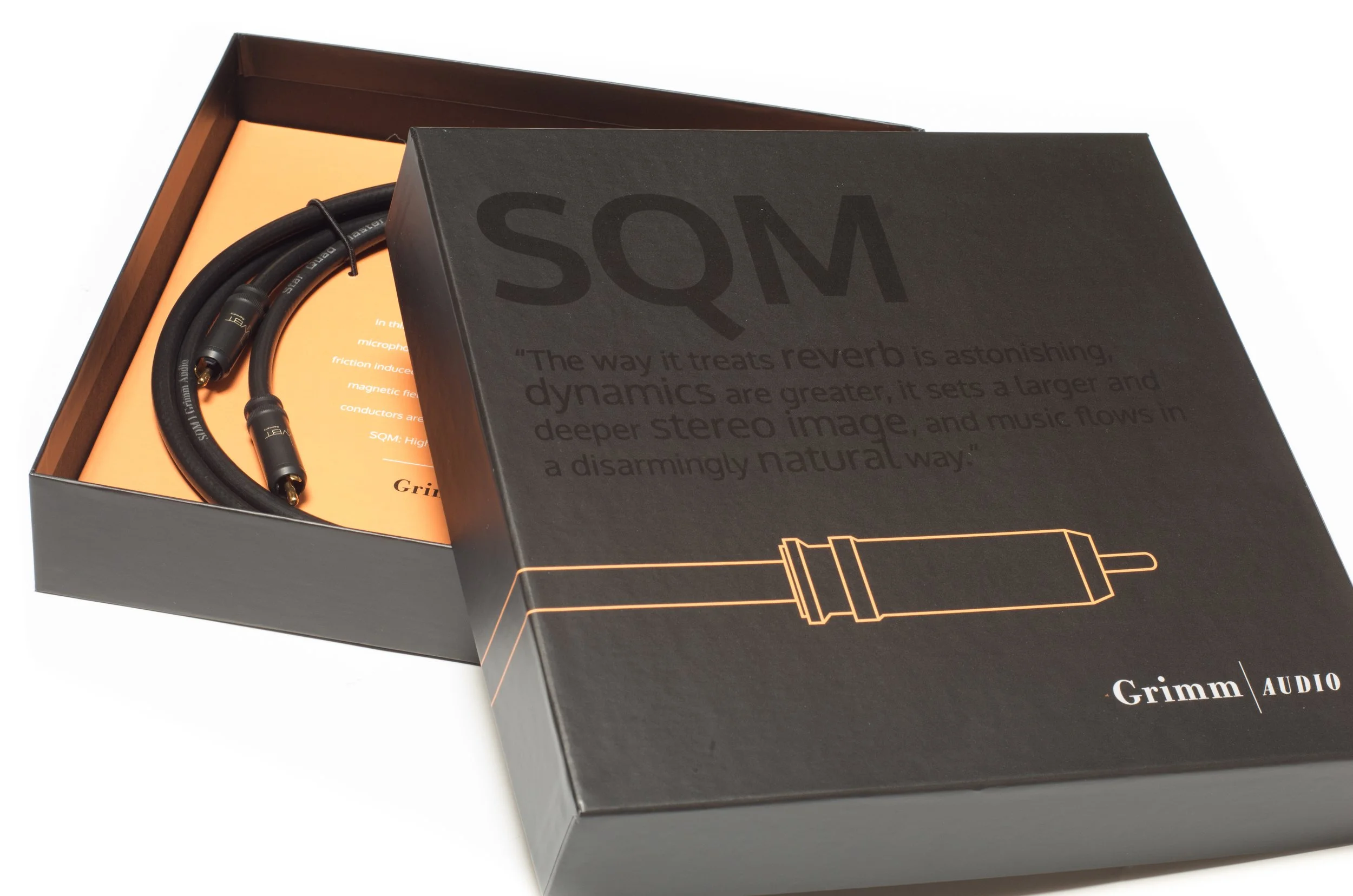
GRIMM AUDIO SQM CABLES - REVIEW
I have gone on in some detail regarding those who assume an almost ideological belief in the fact that “there is no difference in the sound of cables, any cables.” And I have heard noted audio manufacturers echo or believe this very same statement. I must admit that the latter revelation was indeed both perplexing and shocking. How could someone in the audio industry, some one who sets about building components with their various microchips, resistors, capacitors, power sources, differing wires, etc., not know? I have pondered long and hard on this, and have arrived at two conclusions.
The first conclusion is that the believer/proselytizer who “knows” that cables don’t make a difference has never actually undertaken the empirical research to validate their “hypothesis.” The second is that their hearing and ability to differentiate macro—large-scale changes in sound—let alone micro—small changes in sound—have long ago abandoned them, if indeed they were ever in possession of such abilities.
The second conclusion took considerably more thought as to how someone steeped in the audio industry, in many cases for decades, would not know that cables absolutely make a difference. Is this a belief system so rigid as to vehemently discard any new information, even their own insights and observations? Or is it that their hearing ability has long ago abandoned them, analogous to a deaf Beethoven or, more tangentially, a Monet with diminishing eyesight?
In truth, this is a topic that boggles the mind. Especially so when I can perform a comparison with a teen-aged girl and two power cords—a standard power cord and, say, Paul Spetlz’s AntiCable Level 3 power cord—and she gets the difference, literally in seconds! She has no buy-in, is not an audiophile, and has embraced no dogma, yet she gets it clearly.
Over time, I have evaluated and reviewed a number of cable products, ranging from entry level cables and cable looms to reference level cables and cable looms. And I have a bet for anyone whose hearing remains intact that differences do exist between cables, and in many if not most cases, those differences can easily be discerned (see power cable example above).
This brings me to my current cable review, Grimm Audio’s SQM cables, which have proved decisively that technological advancement proceeds at a rather frightening pace, that the applied science has decidedly homed in on cable design, and that the least expensive cables are now competing easily with some of the most expensive cables (see SQM cables). Well, how do those SQM cables sound, and which expensive cables have they “soundly” defeated? In the end, this may be a far shorter review than intended, and the reason will become quite clear.
REFRAIN: Unlike most reviews, this review will be non-sequential, as it will start with how the equipment actually sounds and not the process of physically “undressing” it and/or laying out its various accoutrement, specifications, etc. Think of this review then, as a non-linear movie—Memento, Kill Bill, Pulp Fiction, Eternal Sunshine of the Spotless Mind, The Queen’s Gambit, In the Shadow of the Moon, etc.—that likewise starts at the end and winds its way to the beginning.
THE SETUP
The Grimm Audio SQM cables were reviewed in the context of two audio systems— the reference two-channel and the reference headphone, both systems detailed below.
I received SQM interconnect cables only—two balanced sets and two single-ended sets (itemized below). So while not a full cable loom, the cables would be placed to give a full accounting compared to the cables that had been removed.
Grimm Audio SQM XLR Interconnects (1-1.5m, 1-2.0m)
Grimm Audio SQM Single-Ended Interconnect (1-1.5m, 1-2.0m)
As in all cable reviews, I kept things simple in terms of the streams that would be used for evaluation—all streams very well known to me. The tracks utilized were:
Dave Brubeck’s Take Five (Time Out, Columbia)
Ólafur Arnalds Árbakkinn, (Island Songs, ECM)
Eiji Oue’s Stravinsky (Reference Recordings)
Vangelis’ Blade Runner Soundtrack (East West UK), and
Joan Shelley’s eponymous album (No Quarter)
The Reference System - Headphone
Grimm Audio MU1 Streamer
Silent Angel Rhein Z1 Streamer
Silent Angel Forester F2 Power Supply
Silent Angel Bonn NX Network Switch
Silent Angel Genesis GX Clock
Bricasti Design M1 Special Edition DAC
Border Patrol SE-1 DAC
Aurorasound HEADA Headphone Amplifier
HeadAmp CFA3 Headphone Amplifier
Pass Labs HPA-1 Headphone Amplifier
Dan Clark EXPANSE Headphones
HIFIMAN Susvara Headphones
ABYSS AB1266 Phi TC Headphones
Meze Empyrean Headphones
Audience FrontRow Interconnects (XLR, RCA), USB, Ethernet
AntiCable Interconnects (XLR, RCA), USB
Kubala-Sosna Interconnects (XLR, RCA), Power cords
Grimm Audio SQM Interconnects (XLR, RCA)
RSX BEYOND, MAX Power Cords
TORUS AUDIO AVR ELITE Power Conditioner
The Reference System - Two-Channel
Grimm Audio MU2 Streamer/DAC/Preamplifier
AIR-TIGHT ATC - 5s Preamplifier
AIR-TIGHT ATM - 1E Amplifier
ATMA-SPHERE - GEM Integrated
LYRIC Ti 100 MkII Single-Ended Integrated
Franco Serblin Accordo Essence Speakers
Fern & Roby Raven III Speakers
Kubala-Sosna Interconnects (XLR, RCA), Speaker Cables, Power Cords
Grimm Audio SQM Interconnects (XLR, RCA)
TORUS AUDIO Power Conditioner
RSX BEYOND, MAX Power Cords
SEISMION REACTIO 51 Amplifier Stand (powered)
THE SOUND
The Grimm Audio SQM cables would be reviewed via a top-to-bottom “sound-off’”versus various cables that were in-house and those that had just come in to be reviewed. Or at least that’s the way I had intended things to proceed, but the wholly unexpected abilities of the SQM balanced and single-ended interconnects would in fact rewrite the script entirely again, making for a short review.
Placing the SQM XLR balanced cables in the Reference Headphone system, absent the benefit of complete burn-in, was nonetheless an eye-opening, mouth-agape epiphany. All the cables that were not considered reference or Top-of-the-Line (TOTL) cables in a manufacturer’s offering were quickly and soundly surpassed in all technical, musical, and immersive abilities. It was not even close, and this called for several minutes of quiet to determine what had just happened. After reflection, I pressed on to determine whether or not this had been an anomaly, a one-off, or perhaps a mistake on my part. The initial observations held firm. The Grimm Audio SQM balanced interconnect was the strongest cable in every respect, as it made the other cables sound deficient and lacking in technical acumen and refinement. Whoa! The various cables prior to the SQM had been either at the top of their respective price range or they represented the TOTL of their respective manufacturers.
When it came to the TOTL cables, well, at least the penultimate—second or third from the top or ultimate—while they were not dispatched in the selfsame way as the other cables, there were clear differences in technical abilities, presentation of space, at any given venue, musicality, and quiet. The SQM had again come out on top against cables five to six times its suggested retail price—$710/pair (2.0m XLR)! And against the ultimate TOTL cables at seven to eight times the SQM cable’s pricing, the SQM were either matched across all parameters while providing a more natural presentation, or they excelled in certain other areas—spatial representation—soundstage width, depth, separation, and layering, slightly above the TOTL cables. And this was a rather shocking revelation, given the extreme pricing differences between the TOTL and Grimm Audio SQM cables. They only in-house cables that handily weathered the storm of the SQM cables were Kubala-Sosna’s top interconnect cables.
I had had an epiphany decades ago, when a friend introduced me to what was a rather obscure cable that he believed would best the cables that were currently in my system. I asked what those cables cost and he gave me a very low number. I scoffed and remember saying something like, “Do you know how much these cables cost? There’s no way.” He laughed, gave me the cables, and subsequently my belief, a belief that I imagine every audiophile entertains at one time—more expensive is better—was roundly shattered. Those much less expensive cables were far better than the expensive cables in my system.
“But how do the SQM cables actually sound?” you ask. Well, the short answer is that they sound very much like the TOTL cables that I have written about across these pages, though at relatively speaking bargain basement prices. There is, however, the added quiet, a quite profound naturalness, and the meticulous staging of your music, that “sorts” out musicians in and across a given venue to its depths, width, and their relative spacing that few cables have achieved. The other descriptors relative to the SQM are its rendering of tone/timbre, which is more in line with a box of 120 crayons as opposed to the standard 24 or 96 crayons. This, of course, extends expressiveness and, in turn, a naturalness, an immersion into one’s music that is rather compelling. And the fine—read smaller—diameter of the SQM relative to the often much larger diameter of the TOTL cables does not diminish by an iota of a whit any difference. Thus the bass rendered by the SQM is substantive, deep, tight, well-resolved, clear, and beautifully textured.

On Dave Brubeck’s Take Five, Joe Morello’s cymbals were superbly resolved and perhaps more natural than I have ever heard them. The birds on Ólafur Arnalds’ “Árbakkinn” appeared earlier in the mix and were easily differentiated, and Joan Shelley’s voice on her eponymous album was rich, textured, well articulated, and in-room.
The current epiphany of epiphanies? Yes, and for a very interesting reason. When I received the SQM cables, I was not aware of their pricing and would not be made aware of their cost until the review was near its conclusion. Whether this was intentional, to avoid biasing my opinion, or a direct result of Grimm Audio being incredibly busy—shows, Grimm Audio MU2 debut, etc.—I don’t know. What I do know is that when I discovered the actual pricing of the SQM cables, I was truly and profoundly shocked. How could it be that these cables at mid-fi level pricing were performing so excellently and at TOTL level pricing? Grimm’s explanation:
“SQM takes the Grimm Audio cable philosophy of low microphonics and proper shielding to the next level. The resulting sound quality is a serious step up from Grimm’s already excellent TPR cable. The way it treats reverb is astonishing, dynamics are greater, it sets a larger and deeper stereo image, and music flows in a disarmingly natural way.”
I do not believe that a company’s design philosophy and subsequent marketing slogan have ever been borne out so accurately as with the Grimm Audio SQM cables.
CONCLUSION
Yes, the Grimm Audio SQM cables are mind-boggling, as they compete, no scratch that, out-compete Top-of-the-Line (TOTL) cables at many multiples of their cost in a way that defies any semblance of, well, “logic.” One would not think this possible, given the vast disparity of cost between them and the TOTL competitors, but on every metric of music reproduction—technical/spatial, natural musicality, immersiveness—the SQMs were consistently on top. Incredible!
I have written in the past of coming across a compelling product that pushed the boundaries or the wherewithal of a given audio segment—HIFIMAN Susvara, Mola Mola Tambaqui, Grimm Audio MU2, SEISMION REACTIO 51, etc.—but their realm was always at TOTL designation in terms of relative cost. The SQM, per its pricing, is far from that designation, but it performs as though it is, and comfortably so.
This is perhaps one of the easiest and highest recommendations that I have made for a product, and given its costs and its abilities, at orders of magnitude above its cost. The Grimm Audio SQM cables are clearly and easily DIAMOND AWARD winners of the first degree and, dare I say, BREAKTHROUGH AWARD winners as well. As I say with most components and cables of such abilities, you will see them again in our Awards Issue, where they will no doubt bag a few more well-deserved awards.
Pros: Exceptional in their ability to supplant cables at many multiples of their price, while providing exceptional levels of performance when it comes to rendering music in technical/spatial, natural, and immersively engaging ways. Cables are indeed incredibly important to the fidelity of one’s music.
Cons: None.
COMPANY
GRIMMAUDIO BV
SQM RCA (1.0m/2.0m): $670/$765
SQM XLR (1.0m/2.0m): $615/$710
Zandven 6
5508 RN Veldhoven
The Netherlands
info@grimmaudio.com
Or call: +31 40 213 1562