SOTA COMET VI TURNTABLE - REVIEW
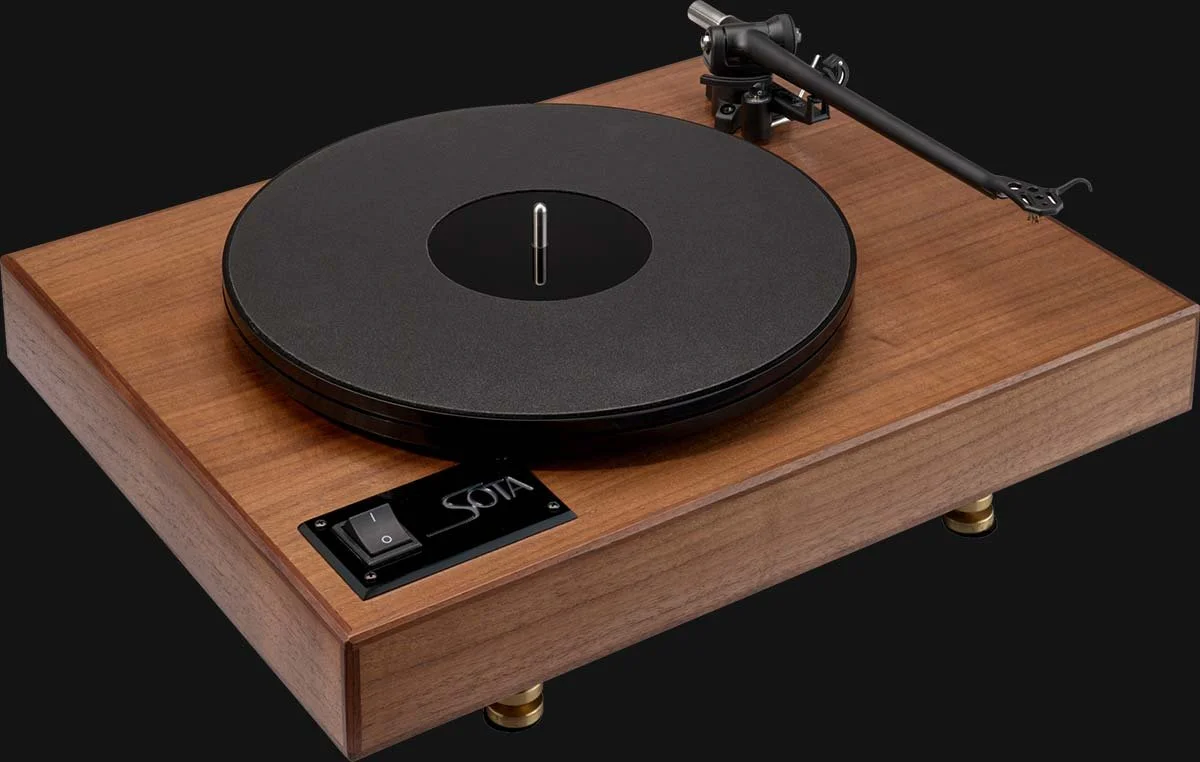
SOTA Comet VI Turntable & Pyxi Phonostage:
SOTA Sound Inventions has been one of the most respected manufacturers in the hi-fi industry for over four decades. They have a devoted user base and are rightly known for their high value products and virtually unrivaled dedication to servicing and repairing legacy products. SOTA proudly makes their products in their manufacturing facility in Delavan, Wisconsin.
The company is beloved for a good many reasons. Their turntables and accessories are all designed using solid, time-tested engineering. They don’t pivot with every new trend or fad in design. They make products for all budgets, and speaking from experience, they are wonderful people who cater to music lovers.
We were very excited to receive for review the latest edition of the Comet turntable, the Comet VI. Many of their products have names related to the cosmos, which strikes a chord with this astronomy buff! We also received the new Pyxi phono stage along with the turntable.
The Comet VI has a base price of $2,125, and comes equipped with a Rega RB330 tonearm. It is available in Oak, American Cherry or American Walnut wood veneers. The unit can be shipped with no cartridge or with a choice of Moving Magnet or Moving Coil. cartridge preinstalled. The turntable is lovely in appearance and a breeze to set up.
SOTA’s attention to detail in the packaging and documentation is excellent.
Their attention to matters regarding both vibration and resonance goes above and beyond most manufacturers. SOTA uses several types of energy-dissipating polymer materials throughout. This applies to several areas, including the main platter, the sub-platter and the bearing cup assembly. Rounding out resonance control is dampening in the chassis and specially designed feet.
The unit is driven by a 24-pole AC synchronous for precise timing and a low tension belt ensures smooth operation, Of course, the Comet IV spins at both 33 1/3 and 45 RPM. A dust cover is available at additional cost, as is a low mass beautifully made clamp, which we did receive with the review sample. SOTA feels the clamp offers a distinct performance, so we used it with every record we spun. The review sample we received was outfitted with the Audio Technica AT33SA Moving Coil cartridge.
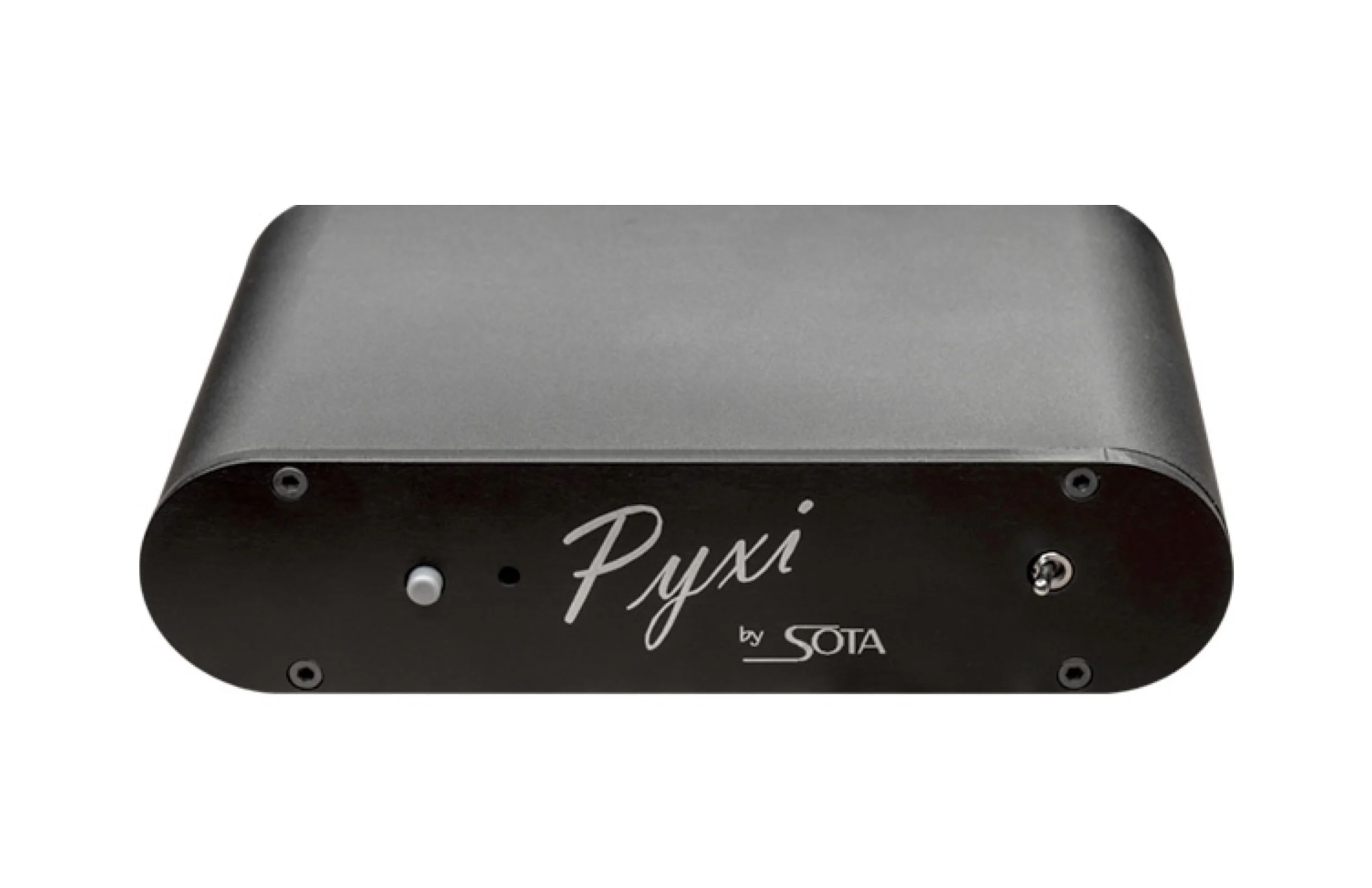
The Pyxi phono preamp retails for $300 and does not appear to be just a “me too” product. SOTA worked with respected firm Phoenix Engineering to develop the unit. The goal was ultra low noise, a clean signal path, and a balanced, transparent sonic character. They paid particular attention to part quality, specifying 1 percent resistors for consistent performance, highly unusual at this price point. The unit also has a sleek appearance, with a small footprint and adjustments for Moving Magnet and Moving Coil cartridges. A white paper was even produced that details the design: https://sotaturntables.com/wp-content/uploads/2023/02/sota-pyxi-whitepaper.pdf
Set-up and listening
Setting up the Comet VI was a breeze. From unpacking to spinning vinyl, barely 20 minutes passed. Some minor assembly involving the platter, balancing the tonearm and setting the tracking force was essentially all that was required. The company even supplies a level to make sure the table is on an even footing.
The rest of the system was comprised of a Rogue RP-5 tube preamp, a Simaudio 330A power amp, Magnepan 1.7i speakers, and the aforementioned SOTA Pyxi phono preamp. Cabling was all Clarus through and through (REVIEW LINK). Everything was plugged into Bryston and Audience power conditioners. We placed the Comet VI on a Symposium Rollerblocks and a Svlete Shelf, which to our ears are the best external resonance control devices we have ever tried.
The first album I spun was a hard-to-find pressing of Fairfield Parlour’s one and only album, From Home To Home. The music is heavy art rock, with Mellotron, guitars, poetic lyrics and amazingly melodic songs. I noticed surface noise was far less prominent than on previous spins, and the imaging was very precise. I could identify subtle background parts in the mix that previously were rather obscured. This is an example of a pressing that, although musically sublime, was not stellar from a physical perspective, but the Comet VI seemed to dive in and extract the best from the platter.
The Who just released a massive archival box set of their iconic album Who’s Next, which was linked to a convoluted project called Life House that Pete Townshend had worked on for several years. The 120-track plus release has the original album remastered, tons of demos and live recordings. I pulled out an original MCA pressing of Who’s Next from the early 1970s and gave it a spin.
We were simply blown away at how fresh this pressing sounded through the Comet VI. We really thought there was nothing new we could extract from this record, but we were proven wrong. The opening synthesizer riff and piano chords to “Baba O’Reilly” had the perfect amount of percussive quality and decay, and when the bass and vocals kick in there is superb impact and dynamics. Well done, SOTA.
We wanted to throw some curve balls in, so we picked something more contemporary. We picked Music For The Age Of Miracles by one of our favourite modern bands, The Clientele. Their music is ornate chamber pop, with a strong mid-period Beatles influence. We were astonished at how spacious, holographic and immersive this LP sounded with the Comet VI. The songs are lovely, with expansive melodies and breathtaking vocals. The Comet VI shone a light on the grand sweep of the arrangements, yet also provided the impact and the guitars and drums.
Up next was an excellent discovery we made last year on the Night Dreamer label. They produce all analog direct-to-disc recordings of world music, jazz and other exotic genres. The album pressings are of exceptional quality. The Comet VI and Pyxi combo brought all the goodness and immediacy that Direct To Disc platters are known for. Percussion, bass and brass had so much texture and presence, it was literally the next best thing to being there. There was also plenty of recording space ambience.
We made sure to listen to many more records, varying the genre and vintage. The overall picture we have of the Comet VI is that it is very good, with both macro dynamics, the big swings in volume, and micro dynamics, the small, subtle nuances of support instruments. Of course, your choice of cartridge and other gear will ultimately determine how much you enjoy playback, but the Comet VI will likely sound great regardless.
The Comet VI worked flawlessly for the months we had it in house. We should also mention the speed was spot on, measured via various iPhone apps. The table was amazingly quiet as well mechanically—zero hum or any other incidental sounds could be detected.
We also highly recommend the optional clamp. It really did make a difference, especially in imaging and bass coherency. The difference was obvious from the first use. Now for a few words of caution: if you are a compulsive tinkerer who wants to adjust every parameter for various records, you may want to look elsewhere. No VTA adjustment, etc. We are not one of those listeners and vinyl enthusiasts. We are FIRMLY in the Set It And Forget It camp.
That being said, we trust SOTA has taken care of all the major parameters needed for pleasurable listening. They have addressed vibration and speed accuracy, and the Rega RB330 tonearm is an excellent choice with its low mass rigid design. The last piece of the puzzle to complete the Comet VI package would be to order the optional dust cover, if so desired.
Conclusion
There is no other way to put it: we fell in love with the SOTA Comet VI turntable. It offered performance beyond its price point and the pride of ownership is off the charts. The Comet VI made old favourites sound fresh and vital and had us doing internal crate digging, looking for records we have not played in some time.
At around $2,500 for the package, depending on the cartridge, the Comet VI is an absolute steal. The same applies to the magical little box called the Pyxi. At $300 it puts itself at the head of the pack for affordable phono preamps. No, it did not outclass phonostages costing ten times more that we had in house, but it sure was closer than we could have imagined.
SOTA is exactly the type of company I enjoy supporting as a consumer and enthusiast. They take the quality of their products and customer satisfaction quite personally. They make turntables that any music lover would fall for, and you can rest easy that the product will be supported going forward.Of course, we can surmise unreservedly that moving up the SOTA line gets you higher end performance, so which turntable you choose to audition will depend on your budget and listening habits.
Product information
Comet specifications
Weight: 26 lb (12 kg)
Dimensions: 6-1/4″ H (to top of dust cover), 18-1/4″ W, 14-1/4 ” D
Tonearm: Rega RB330
Sub-platter: White polyoxymethylene precision-machined
Bearing: Hardened chrome ball
Plinth: 3.125” Medium density fibreboard with constrained dampening material
Motor: 24-pole AC synchronous motor.
Speeds: 33/45 rpm
Pulley: Aircraft grade aluminum, dual speed design
Finishes: Oak, American Cherry, American Walnut wood veneer
SOTA
Comet VI Base Price: $2,125
Pyxi Phono Preamp: $300
sotaturntables.com/products/comet-vi/