AUDIENCE FRONTROW RESERVE - REVIEW
AUDIENCE FRONTROW RESERVE
My various reference systems have been in a bit of a transition. That is to say, that my reference headphone system is now stabilizing. This while my two-channel system is being strengthened with the addition of a CD transport of tremendously high caliber—technically and musically superb—to couple to my reference DAC—Bricasti Design M1SE. Suffice to say, that in testing all manner of CD transports with the Bricasti M1SE DAC, the M1SE has proven itself time superior to much higher priced DACs. And the combinations, regardless of CD Transports with the M1SE have been exceptional to outstanding. Even the least expensive CD transport—Shanling ET3 ($893)—as coupled to the M1SE did not embarrass itself amongst streamers ten to twenty times more expensive! In fact, in a couple of cases, the ET3 outperformed several of these streamers, when coupled to the M1SE!
My interest in a CD transport came after my current residence assured me, on several occasions, that fiber optics was built in. It wasn’t. And ongoing fiber optics installation glitches to correct the false statements made by my landlord resulted in a nearly six week glitch that has hampered operations. However, had there been no CD transports to spin the music, production and operation may well have come to a halt. Madness would have, no doubt, ensued. Though I’m promised this will be addressed shortly.
Not only was madness averted, an epiphany was had, as I had no choice but to spend more time with CD playback. The various CD transports, again, even the least expensive as mentioned above, were either coming very close, matching, or outperforming much more expensive Streamer/DAC combos! In some cases the streaming device was itself more expensive than both the DAC and the CD Transport! Oh revelation! Of course, the breakthrough streamers—Grimm Audio MU2, Baetis Audio Reference Mingo—still outperformed the various DAC/CD Transport combos, but only if the tracks were stored and played back from internal storage caches. Otherwise, it was ‘nip and tuck’.
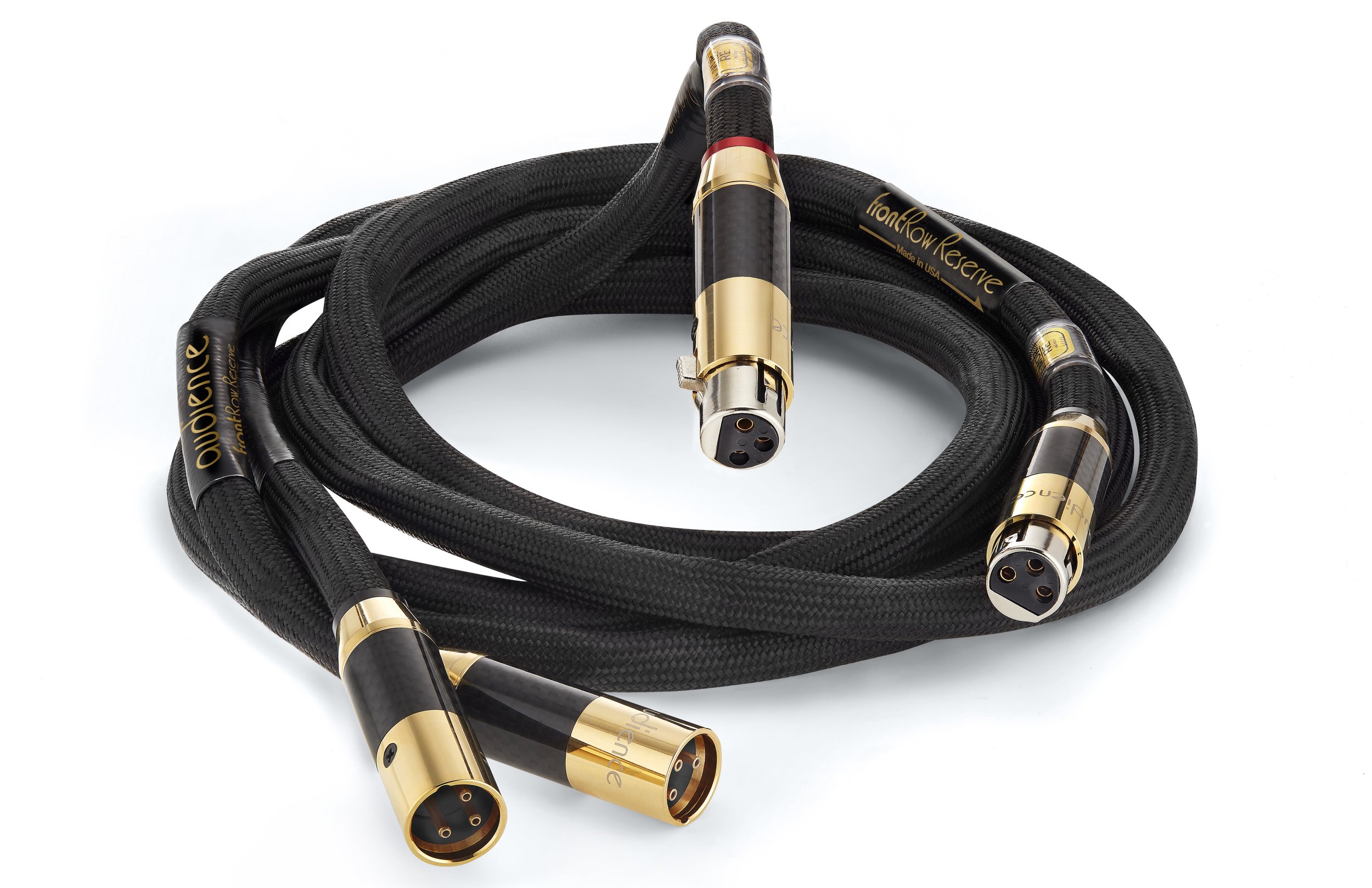
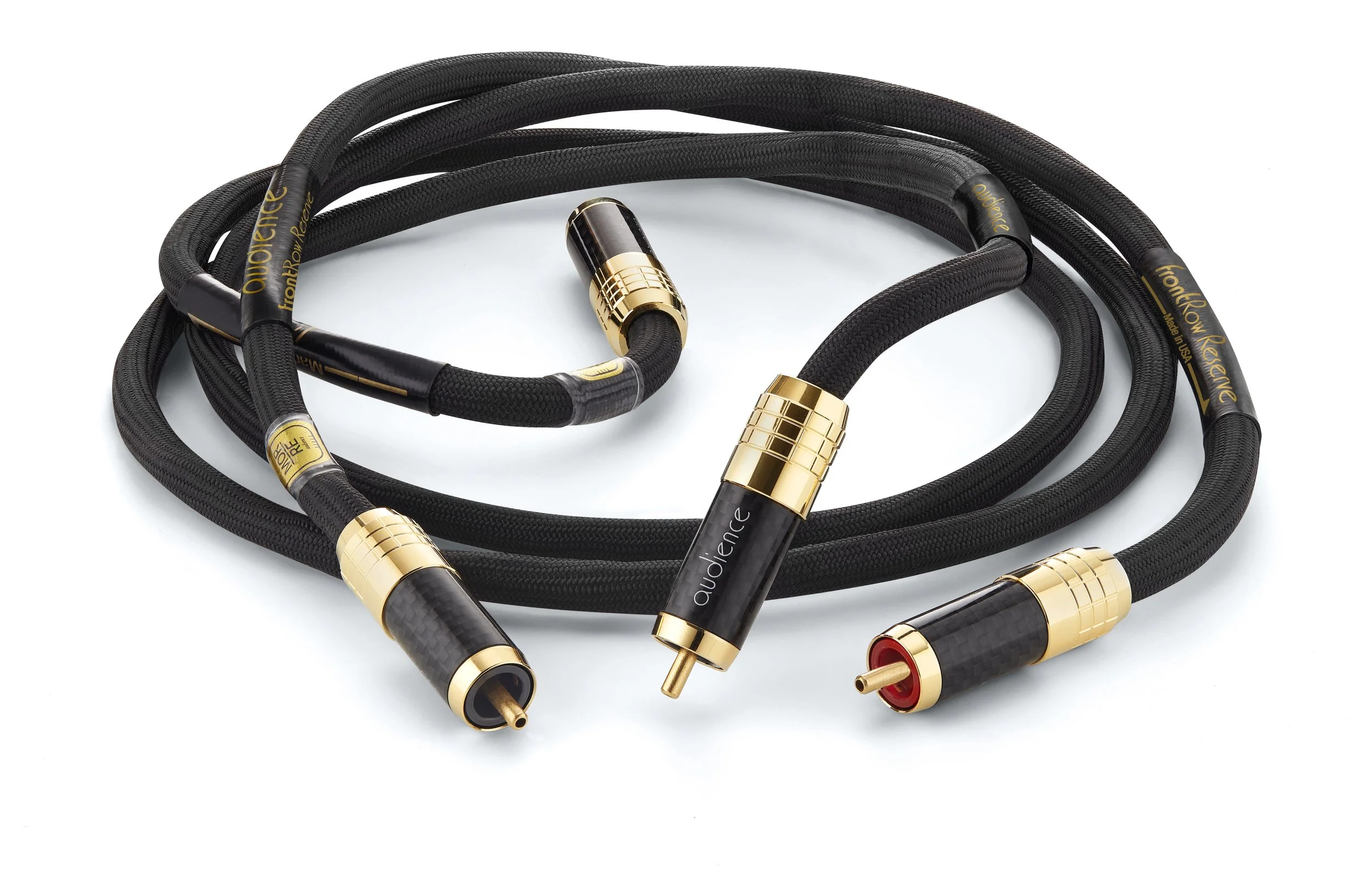
This review is not about streamers or CD transports or DACs, it’s about Audience’s new Top-of-the-Line FrontRowReserve (AFRR) RCA and XLR interconnects, which played a crucial role in shedding light on the various CD Transport/DAC combination, given their many outstanding talents.
The AFRR cables became exceptional arbiters in providing insight far beyond the much more expensive cables that had long been a part of my two-channel reference system. In this respect, they lifted the bar, with regard to overall performance, dismissed price as a consideration, and moved quite a bit beyond their siblings—the original Audience FrontRow cables. But how good are the AFRR?
The Sound
Important. You will need to allow 400+ hours of burn-in before the AFRR cables come into their own. Believe me, their burn-in time will be time well spent to the benefit of one’s entire system. This is what I experienced with the AFRR cables.
Prior to the 400+ hours of burn-in there were growing pangs of disappointment. “Well, they don’t sound as good as the FrontRow cables did,” I’d say. However, as the time passed and the hours mounted, the AFFR cables soon surpassed the FrontRow cables easily and by every measure. This was the proverbial ugly duckling becoming a most beautiful swan. And when the cable ‘swan’ performed in my systems—reference headphone and reference two-channel—though I am a man of words, I searched for words to describe their extraordinary performance.
The original Audience FrontRow Reserve cables were themselves quite exceptional. They often reminded me of what I consider the best headphone technology, to date—electrostatic headphone/amplifier technology. For me the proverbial desert island stay would have electrostatic headphones (STAX SR-X9000) and an electrostatic headphone amplifier (either STAX SRM-T8000 or HeadAmp’s Blue Hawaii Special Edition) on the list. Additionally, there would be the Bricasti Design M1SE, as streaming on the desert island would be a zero-sum event. There I’d be spinning CDs to the cows come home, without the faintest concern for the internet. And that desert island system would be wired with AFRR interconnect cables, given my experience over the past several months and here’s why?
When the AFRR cables truly came into their own, there was now a decided gap between the two sibling interconnect cables. The AFRR had simply outdone the FrontRow in terms of their electrostatic and soundstaging abilities. Width, depth, separation, layering with the AFRR were on a level above the original FrontRow cables and ever more closely related to electrostatic, which are second to none in this respect.
Further transparency, resolution, and detail were outstanding! And coupled with the AFFRs superb tone, timbre, texture, you now hear the performers and the ‘volume’—external and internal—of their various instruments! Volume you ask? These are the internal and/or external reverberations of violins/cellos, their strings bowed or plucked, which is inseparable from the music. Or the internal and/or external reverberations of drums, congas, bongos, again inseparable from the music, yet which so few systems (i.e. wires) appear to capture. The previous reference wires had certainly not detailed this level of information. At best they had portrayed a ghost of this information. The AFFRs, on the other-hand, provided both form/dimension as well as the instrument’s external and internal volume via reverberant cavities. Outstanding! Bravo!
It was truly stunning to hear the music and the instrumental cues like I had never before heard them. It was as if sitting in the front row (or on stage) of a concert hall or a small jazz venue or in a cafe immediately before a folk singer. You were there with the music, their voice and also their instrument(s) and its various reverberations.
This and the electrostatic nature of the AFRR cables confer greater closeness, intimacy and thus an exceptional ‘you are there’ experience. It was a constant theme across all genres of music with the AFRR in the system, that much more expensive cables could not pull off! And while there were certainly points of difference between the cables with some ceding to the more expensive cable—marginally greater weight and dynamics, neutrality. The balance—transparency, resolution, detail, their ability to easily parse tone, timbre, texture and their subtleties, their wondrous musicality, and the ability to portray volume—all found favor with the AFRR cables. Time after time, the much less expensive AFRR cables won the day. There soon came a point during the review, when the AFRR cables found permanent placement in my two-channel reference system. There was no longer any point going back and forward and I never looked back.
In terms of the AFRR’s ability to handle the frequency spectrum—low bass to midrange to high treble—in this too it moved beyond the higher price reference cables and far beyond its sibling.
Bass was taunt, its notes well differentiated, transparent and beautifully resolved. The thump, thump, undifferentiated bass of the other cables on certain CDs—Kind of Blue (Miles Davis)—was now clean, lickety-split fast, and beautifully textured (with that wonderful internal external volume in tow for the upright bass). It truly boggles the mind that there are some who still believe that cables don’t make a difference. There are only two things this could be—advanced hearing loss, massive cognitive dissonance.
The midrange was musically beautiful. This was something that I had noted with the FrontRow that was so incredibly engaging, that voice—a permanent resident of the midrange—had me playing vocal marathons and in great delight. As I stated in the review of the FrontRow cables:
“The midrange, however, across all genres of music and all configurations was magic. Have you ever been captured by a smile, a voice, a piece of art, a ‘something’ that just wouldn’t let go? Yeah.”
The AFRR has upped even this aspect of midrange performance. No doubt, the increased transparency and resolution, its superb tone/timbre/texture coupled with that ever-present musicality has gone a long way to making this so. More singer marathons anyone? Yes, please. And I’ve been buying heaps of CDs.
The treble, despite the AFRR cable being a fraction of the price of the other cables in the system, lost absolutely nothing to them. Nothing. What was gained or what I gained, as a lover of the treble when so sweetly and silky resolved and yet technically spot on, was yet more magic, more incredibly engaging music. Bravo!
The Audience FrontRowReserve Cable’s volumetric cube—sound stage—is cavernous when called for, and it renders the air and ambiance of space and instruments(!) as if an electrostatic Top-Of-The-Line component. Whether a space is intimate, cathedral-like, its every nuance is observed, attended, catalogued. In truth, I have had deeper front walls and space between the speakers, this, however, made no difference to the AFRR cables and the soundstage was a match to my best setup via the AFRR cables! How then is this possible? Bravo! Bravo!
Design—Look and Feel
XLR, RCA Interconnects
The AFRR cables wear a smooth, black-braided-mesh jacket that is soft to the touch, supple, like its FrontRow siblings, yet it and its jacket are more substantive. Its connectors are of a beautiful gold finish and each is clearly labeled (red, black) and provide for secure connections. I must say they look rather stunning in my system even as connected to the back of the Atma-Sphere MP-3 Preamplifier.
Conclusion
Whereas the Audience FrontRow cables had, indeed, pulled a very convincing electrostatic-like imitation in its way with venues, performances, and performers, the Audience FrontRow Reserves have moved to a, well, higher quantum ‘sound’ level.
What this means is that every aspect of Audience’s original FrontRow cable has been improved by the Audience FrontRow Reserve cables. Some aspects have been marginally improved but improved nonetheless. Other aspects of its performance have seen phenomenal improvement, which is easily conveyed in the listening.
The original Audience FrontRow cables, while superb could not unseat the reference cables, in my system, at the time, which were more than double their price. The Audience FrontRow Reserve cables have unseated the same reference cables that are twice their price and they did so easily.
How good are the Audience FrontRow Reserve cables? They are superb and formidable in their ability not just to challenge much more expensive cables but to overpower them both technically and musically, while saving a buyer thousands of dollars. What better recommendation than that?
The Audience FrontRow Reserve cables have easily won our DIAMOND AWARD for excellence in the pursuit of rendering music that is technically astute and musically superb, and otherworldly engaging.
Pros: Outstanding ability to convey the whole of the music—performers, performances and even the instruments on which they play or sing.
Cons: None.
COMPANY
Audience FrontRow Reserve XLR Interconnects (2m): $6,500
Audience FrontRow Reserve XLR Interconnects (2.5m): $7,100
Audience FrontRow Reserve RCA Interconnects (2m): $5,652
John McDonald
President
john@audience-av.com
Tel: 760-277-4724
Joe Flatt
Customer Service
info@audience-av.com
Tel: 760-471-0202
Tel: 800-565-4390