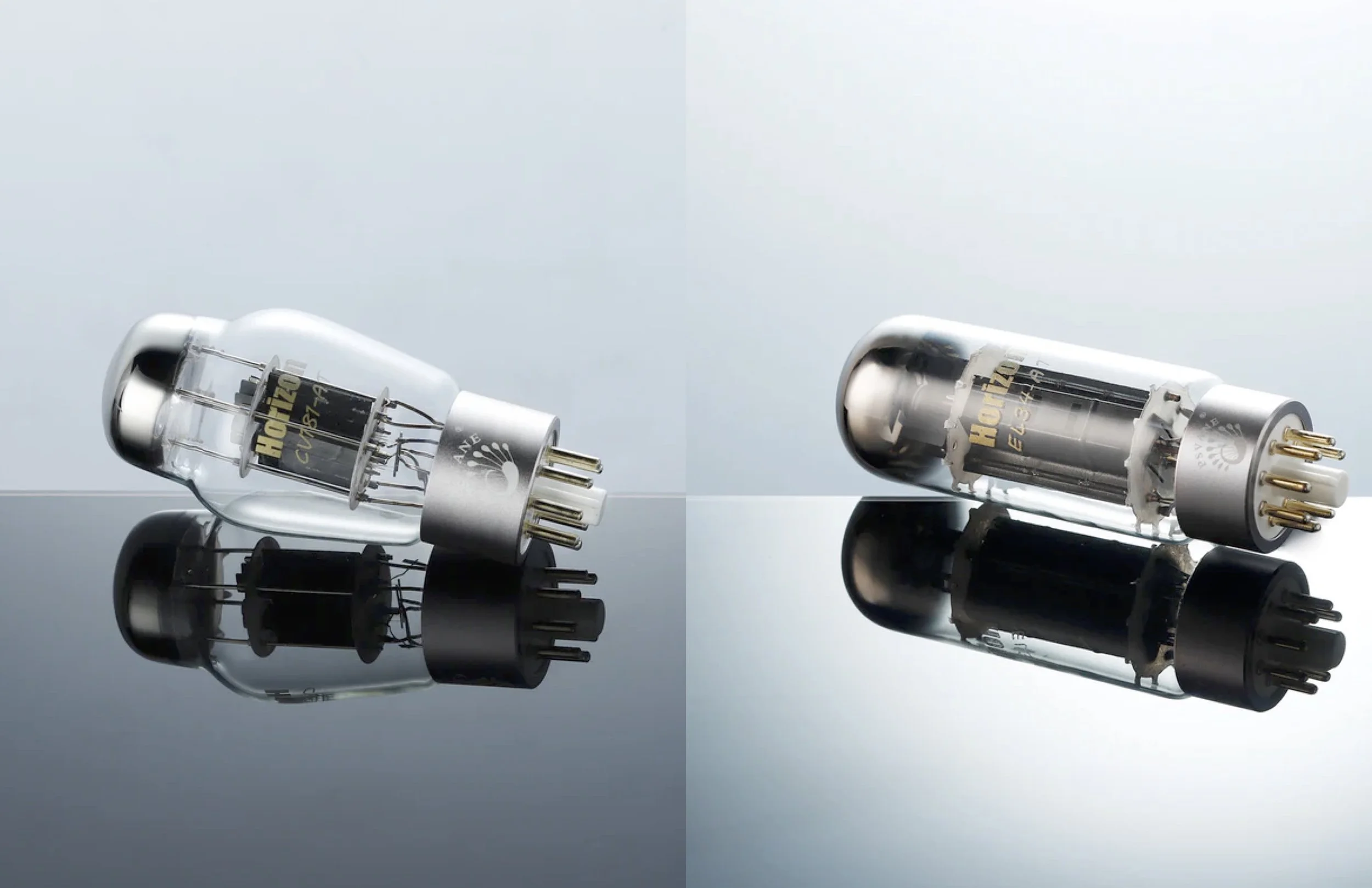
psvane vacuum tubes
I have had a long and happy history with numerous vacuum tube amplifiers, which have sported all manner of tubes from EL84s to EL34s to KT88s to 6SN7s to 6650s to 845s and beyond. Each of the tubes had in many ways its own distinct character or personality or voice and depending on what you wanted—warm, sweet, smooth or dynamic, highly resolving, transparent or powerful textured, etc.—it was just a matter of choosing the proper tube.
Interestingly, the manufacturers of one of the tube amps that I own suggested that I might want to swap out the 6SN7 tubes in its stereo amplifier. I was provided with the name of PSVANE, a relatively new manufacturer of tubes located in China. And as I searched their website, I found a number of other tubes that would work well in my integrated amplifier, that could accommodate a number of power tubes (EL34s, KT88, KT120s, KT150s, KT170s).
I decided at that point that it would be very interesting to see how the PSVANE vacuum tubes faired, as over the year I had experimented with a number of New Old Stock (NOS) tubes from various manufacturers, some of the tubes dating back 70 years(!) though often with mixed results.
I reached out to PSVANE and was immediately in contact with Thomas and Melody, who would handle all of my questions and ship out the various tubes for review. Things moved rather smoothly and in a relatively short time I had several different tube pairs—6SL7s, 6SN7s, EL34s, KT88s—for review in my tubed amplifiers. How would the NOS and other modern vacuum tubes fare against the modern PSVANE vacuum tubes?
REFRAIN: Unlike most reviews, this review will be non-sequential, as it will start with how the equipment actually sounds and not the process of physically “undressing” it and/or laying out its various accoutrement, specifications, etc. Think of this review then, as a non-linear movie—Memento, Kill Bill, Pulp Fiction, Eternal Sunshine of the Spotless Mind, The Queen’s Gambit, In the Shadow of the Moon, etc.—that likewise starts at the end and winds its way to the beginning.
THE SETUP
I used the various PSVANE Horizon tubes in two amplifiers—Atma-Sphere S-30 and the Lyric Audio Ti 100 Mk II. Though the Ti 100 Mk II was malfunctioning it still provided a good sense of the relative difference between the tubes. Suffice to say, the Lyric Audio Ti 100 Mk II will be retired after its use for this review.
Thomas of PSVANE informed me that after 50 hours the tubes would be ready or sufficiently burned-in to begin their review. He was right as initially there was a veil covering their performance, though gravitas—weight and drive—and a good dollop of ambiance and air were already in play. However, after the 50 hours, it was all there both technically and musically for the various PSVANE Horizon tubes.
The various Horizon tubes were used with the amplification as listed below:
Atma-Sphere S-30
Horizon Series 6SN7-AT
Lyric Audio Ti 100 Mk II
Horizon Series 6SL7-AT
Horizon Series KT88
Horizon Series EL34-AT
The System - Reference Two Channel
Grimm Audio MU2 Streamer/DAC/Preamplifier
Silent Angel Bonn Pro8 Network Switch
Air Tight ATC 5s Preamplifier
Air Tight ATM 1E Amplifier
Atma-Sphere MP-3 Preamplifier
Atma-Sphere S-30 Stereo Amplifier
LYRIC Ti 100 Single-Ended Integrated
Devore Audio Orangutan 0/96
Fern & Roby Raven III Speakers
Kubala-Sosna Realization Interconnects, Speaker Cables, Power cords
Grimm Audio SQM Interconnects (XLR, RCA)
RSX BEYOND, MAX Power-cords
SEISMION Amplifier Stand (powered)
TORUS AUDIO Power conditioner
THE SOUND
Atma-Sphere S-30
Horizon Series 6SN7-AT
After the Atma-Sphere MP-3 Preamplifier and S-30 Stereo Amplifier combos outstanding performance in the March 2025 review, I was curious to switch out its 6SN7 to see what if any impact the Horizon 6SN7-AT would have on the combo’s performance.
The six-6SN7 driver tubes in the Atma-Sphere S-30 Stereo Amplifier seemingly New Old Stock (NOS) had worked with the 10 x 6AS7G power tubes to create what I called in its review “performances” as opposed to mere “stereo” playback and this was noticeable from the first track and every track, every album thereafter. In truth, it was, perhaps, the most stunning performance that I had ever experienced from an amplification combo.
When I placed the Horizon 6SN7 in the S-30 I was both curious and a little bit doubtful as to whether these tubes would improve on the sound of the superb and award-winning Atma-Sphere amplifier.
Well, it didn’t take long after the Horizon 6SN7 tubes had been properly burned-in to understand just how good they were. They had, in fact, lifted every area of performance for the S-30 and thus the combo. Gravitas—weight, attack/drive—was immediately improved, as were midrange palpability, in-room presence, and texture. There was a richness and a warmth the previous Atma-Sphere S-30 NOS 6SN7s tubes simply did not have. And this ‘beauty’, for lack of a better word, across the midrange was coupled with greater transparency, resolution, and detail which extended to both the treble+ and sub-bass regions. Further, there was air and ambiance that the previous tubes could not attain. “Wow”, I thought to myself, “What was an outstanding and a DIAMOND AWARD-winning amplifier had been significantly bettered by a change of just four of the S-30’s six 6SN7 tubes!
To date, the PSVANE Horizon 6SN7-ATs have found a permanent home in the Atma-Sphere S-30 Stereo Amplifier.
Note: The PSVANE Horizon 6SN7 are much larger than ordinary 6SN7 tubes, which only allowed for four of the Horizon tubes in the Atma-Sphere S-30.
Lyric Audio Ti 100 Mk II
Horizon 6SL7-AT & Horizon KT88
In its fully-function heyday the Lyric Audio Ti 100 Mk II was truly an exceptional single-ended integrated amplifier. It had handily dismissed other integrated s upwards of twice its price and preamplifier and amplifier combo at prices higher still. It had been my reference integrated up until it started to malfunction.
When I had contacted PSVANE for a review of its tubes, the Ti 100 Mk II was on its way back from being ‘repaired’ at Lyric Audio Germany (see “Debacle with Lyric Audio). I had assumed all would be well again and the Ti 100 Mk II would prove exceptional in reviewing the Horizon 6SL7-AT, KT88, and its EL34-AT tubes. However, despite the fact that it had not been fixed, contrary to Lyric Audio’s opinion, I carried on with the reviews. Apparently, the sick Ti 100 Mk II was still able to do a good job in its analysis/review of the various tubes, while oddly “popping” loudly and chronically across the reviews.
For the first substitution I went for broke. I replaced both the Ti 100 Mk II power tubes—KT170—and its preamplification tubes— 6SL7-AT. I had in the past tried various NOS 6SL7 tubes and while some had improved a given aspect of bass or midrange or the treble (though treble improvement was rare), the NOS tubes were never able to reproduce the full frequency spectrum. Often with the NOS tubes treble would be missing entirely or so truncated as to have erased much that had been in the treble region. And other NOS tubes simply did not have the transparency or the resolution and thus they provided a fraction of the detail that the standard tubes had provided.
I placed the Horizon 6SL7-AT and its KT88 in the Ti 100 Mk II and given my experience with the 6SN7s, I let them burn-in for those 50 hours. When I came back, in short, the prior tubes had been surpassed on every level and in every way. This despite the fact that the KT88 tubes were putting out nearly half the power—ten watts—that the prior tubes, the KT170, had been putting out. “Yikes,” I exclaimed. This was the proverbial beating which the stock KT170 and 6SN7 tubes had gotten from the PSVANE Horizon tubes, as if they had stolen something from them.
It was an experience not unlike the Atma-Sphere combo, earlier reviewed, in which the PSVANE tubes had breathed new life into the music. The technical aspects—soundstaging, resolution, transparency, detail, air, ambiance—were now levels above where they had been. And the musicality was truly superb. Tone/Timbre and texture gave greater presence to performers and their instruments in ways that the prior tubes could not. Voices—Andy Bey, Joan Shelley, Shirley Horn, Sarah Jarosz—were more in-room palpable, textured, and engaging than they had ever been and beautifully so. These were old school meets new school tubes that had been synthesized—analyzed, detailed, built—to an exceptional standard. And they sang to me through the Ti 100 Mk II like I had never heard it before.
Interestingly, I did not move the volume knob, at all, on the Ti 100 Mk II, which remained at 9 O’clock, approximately a quarter of its overall bandwidth. The Grimm Audio MU2’s volume, relative to the Ti 100 Mk II was pushed up maybe two dBs. This I did not expect. Are the tubes more powerful than they are rated? It would seem so.
Horizon 6SL7-AT & Horizon EL34
When I switched out the Horizon KT88 tubes and replaced them with the Horizon EL34 tubes, leaving the Horizon 6SL7 tubes where they belong—home—there was yet another revelation.
The Ti 100 Mk II’s instruction manual states that with EL34 tubes in place the power halves again down to five watts. Given my prior experience, I left the volume control at the same level on the Ti 100 Mk II and on the Grimm Audio MU2 as well. It was an experiment of sorts and I was curious to see the outcome. It was more of the same. I did not adjust the Ti 100 Mk II’s volume control at all, though I did adjust the MU2’s volume control, perhaps, upward 2 to 3 dBs.
Again, I let the EL34 tubes burn-in for a little over 50 hours. And when it came time to listen, the stock KT170 and 6SN7 tubes once again took the proverbial beating as if they had stolen something. The PSVANE Horizon EL34 tubes had reproduced, in toto, all the technical attributes of the Horizon KT88 tubes—incredible soundstaging— greater width, depth, layering, separation—and air, transparency, resolution, detail, etc. They went one further in musicality, richness, and palpability across the midrange, though they could not match the bass weight of the more powerful tubes! Now with the Horizon EL34’s it was as if I could not only hear the pursed lips of Shirley Horn, the rock-gravel, textured voice of Louis Armstrong, the angelic clarity of Sarah Jarosz, I also had a better sense of their in-room presence. This aspect of the Horizon EL34’s was, indeed, more than it had been with the KT88s. Where the Horizon KT88’s excelled was in their weight and power, perhaps, a wee bit more resolution, greater dynamics, and an expanded soundstage. Two sets of tubes had rendered two different hearings on the Ti 100 Mk II integrated. Bravo!
CONCLUSION
Anyone who knows anything about tubes knows that they come with their own personalities, abilities, voices, strengths, and weaknesses or, at least most, do.
This was yet another review where I was not prepared for the outcome, which, in the end, was demonstratively better in every respect, when the PSVANE tubes had replaced the prior tubes. Suffice to say, there was no aspect technically or musically that was not improved by the various PSVANE Horizon tubes, as they proved, truly, superb.
That being said, the outstanding performance of the PSVANE Horizon Series tubes reviewed—6SN7-ATs, 6SL7-ATs, KT88s, and EL34-ATs—easily qualify for our award—GOLD KEYNOTE AWARD—for excellence. Bravo!
Pros: Outstanding in their ability to easily address all aspects of technical performance, while superbly reproducing music that is dynamic and engaging far above all its competitors during the review.
Cons: None.
COMPANY
PSVANE
Horizon Series 6SL7-AT: $119.99/pair
Horizon Series 6SN7-AT: $108.99/pair
Horizon Series EL34-AT: $88.99/pair
Horizon Series KT88: $145.99/pair
Room 602, Building H2, Phase II, Jiahai Industrial Park,
Zhongqing Road, Shaping Street, Kaifu District,
Changsha, Hunan, China 410201
service@psvane.com