CAMBRIDGE AUDIO MXN10+DACM200 - REVIEW
CAMBRIDGE AUDIO MXN10+DACM200
I’m particularly attracted to products in my Goldilocks zone, $1.5K to $12K, but even $3,000 is well outside most people’s budgets. Very high-fidelity gear is available for not a ton of dough… I’m thinking KEF’s LS50 Meta at $1,500 per pair, powered by Orchard Audio’s Starkrimson monoblocks at $1,600 a pair, sourced by U-Turn Audio’s Orbit Plus platter spinner with optional phono preamp ($480 complete). That tidy package is still too rich for many folks’ blood, so for this instalment I bring you a pair of compact high-value electronics from Cambridge Audio.
Back in 2019, I reviewed Cambridge Audio’s $4,500 Edge W stereo power amp for audioXpress, where I stated, “I…have a pair of $10K (each) Class D amps in house and, frankly, the Edge W flattens them without even noticing the bloody corpse in the rearview mirror. If you’re on the hunt for upscale performance at an affordable price…then I cannot endorse the Edge W enough…simply highly recommended!” Having enjoyed that product, I was recently talking with Cambridge Audio’s Matt Reilly, their Head of Biz Dev. I wanted to experience something very affordable but high-performance, so he suggested the dynamic duo of their MXN10 Network Player as source, feeding the notable DacMagic 200M DAC or Digital to Analogue Converter.
BOne big difference is the eventual inclusion of a volume control, and the 2008 introduction of a USB input along with continued refinements to increase jitter immunity. The 200M maintains the unbalanced, and more importantly for me, balanced analog outputs. Balanced outs allow you to employ a long cable run from DAC to amplifier. It also includes three front panel–selectable digital inputs; a USB 2.0 connection plus two AES3 ins on either unbalanced (coaxial) electrical or optical. That optical input, often erroneously referred to as “TOSLINK,” is really a standard 5mm JIS F05 connector carrying the same AES3 serial data stream that’s available from an electrical coax source on an RCA connector. When in doubt, always choose an electrical connection, as POF or Plastic Optical Fibre, the “cable” used by AES optical, induces very high jitter when compared to actual copper wires.
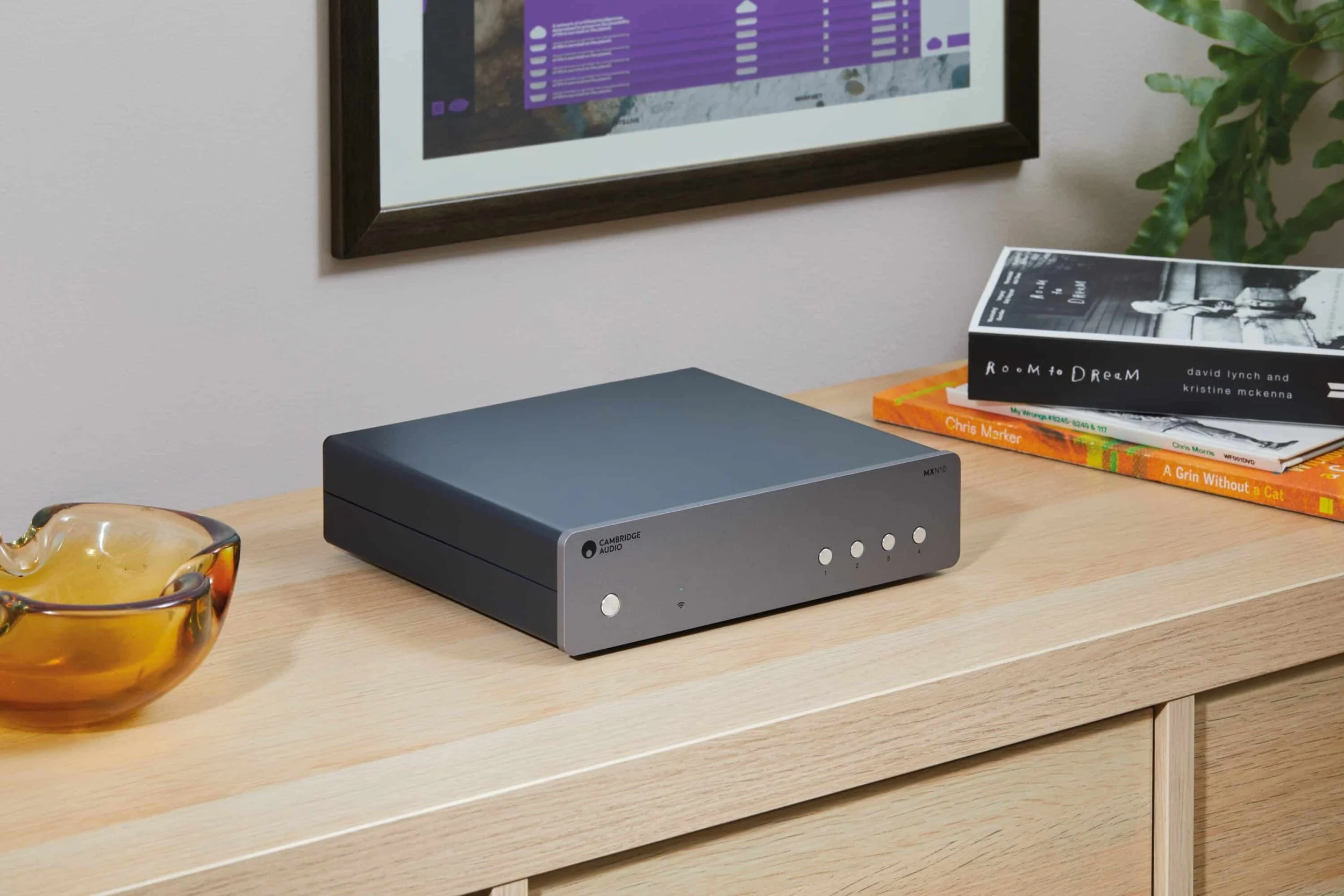
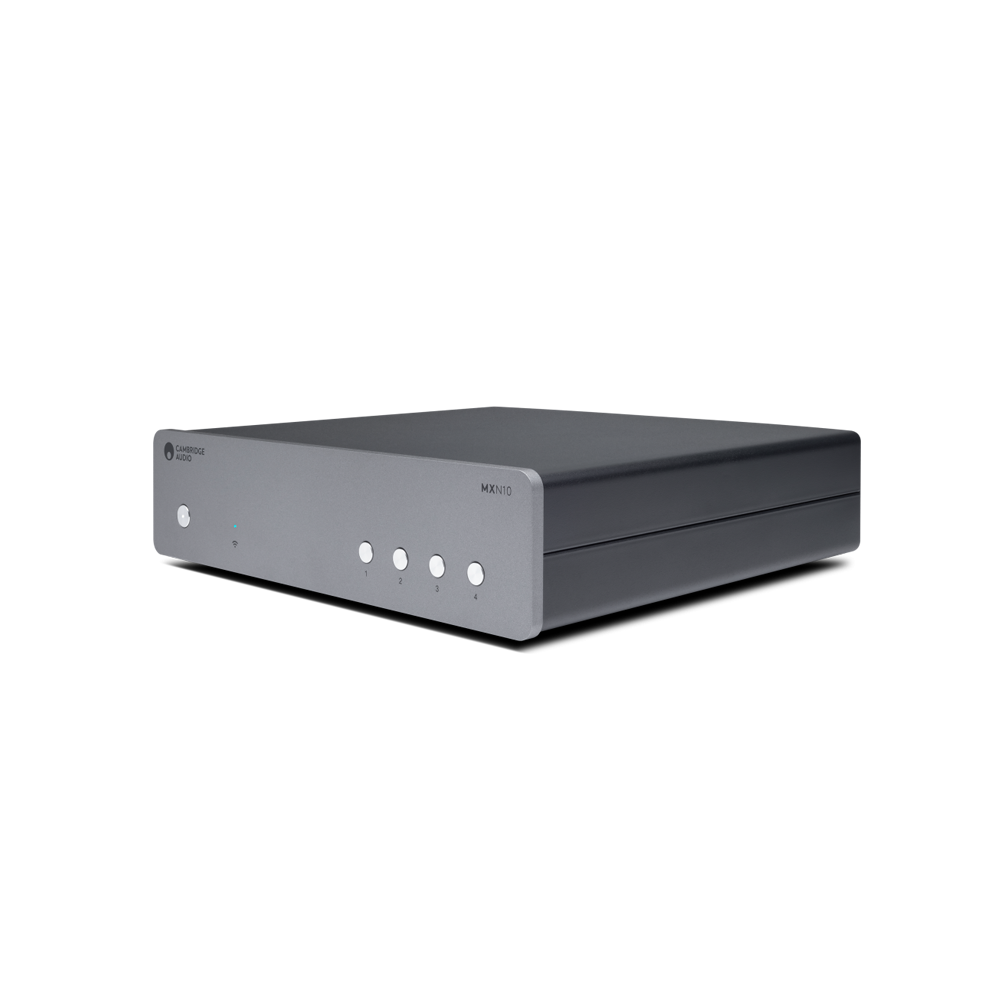
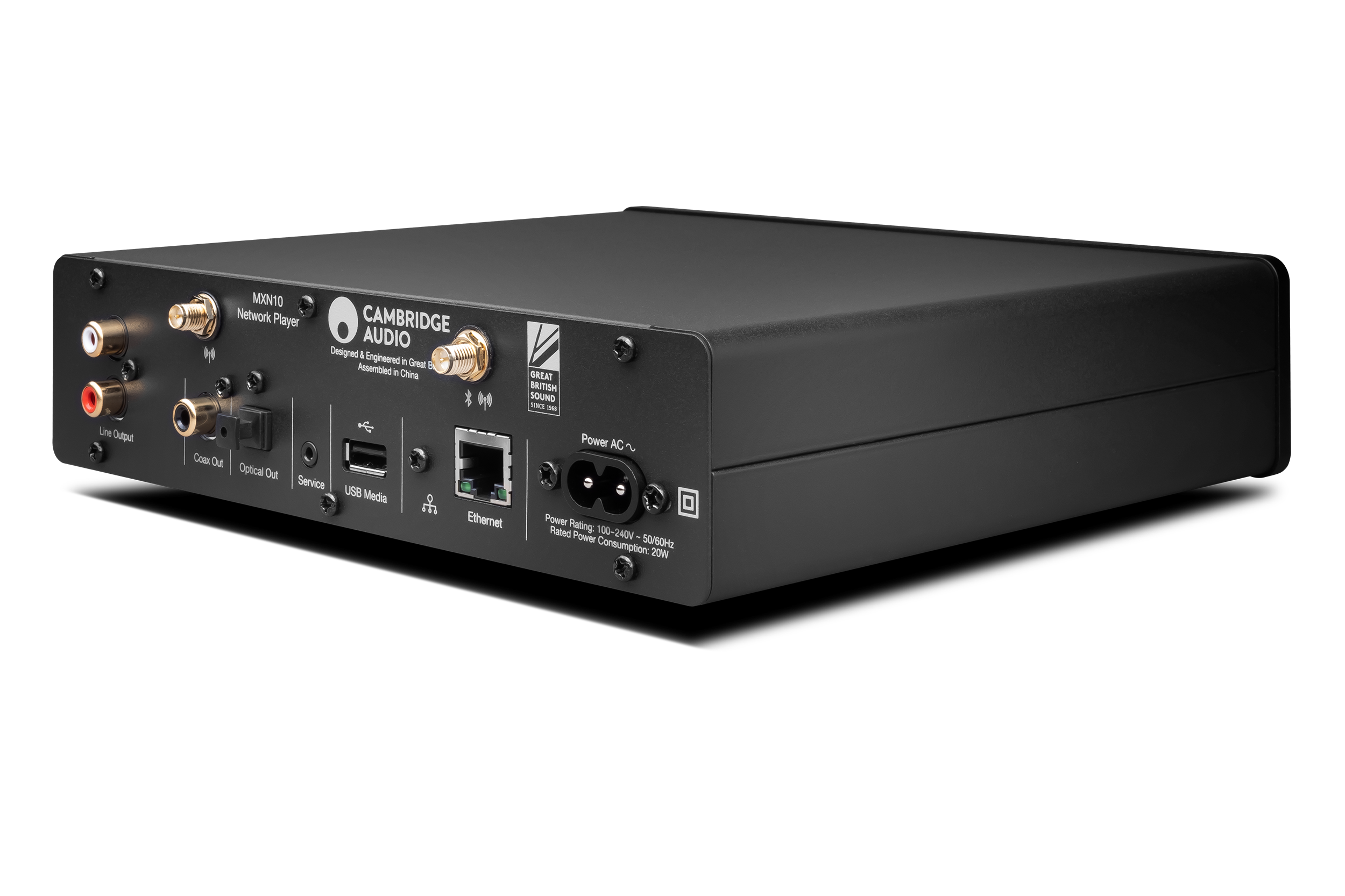
As part of this digital double bill, the $499 MXN10 network player fits nicely in a stack with the $549 DacMagic. The DAC is powered via an external wall wart–style PSU, while the MXN10 utilizes mains power. Both have identical external dimension and similar cosmetics. Each provides a complementary functionality—two great tastes that taste great together. While the MXN10 is certainly a network player, with a wired ethernet input, it can also connect wirelessly using dual band Wi-Fi 5 alongside Bluetooth 5 for ’casting from your phone or tablet. A veritable plethora of standards are supported within those connectivity choices, from lossy lo–fi UPnP, internet “radio,” Spotify connect, Airplay 2 and Chromecast, to hi–fi TIDAL and Qobuz. That said, the MXN10 has no analog or digital ins from another component. Hence the 200M.
Another high-fidelity source choice for the MXN10 is a USB mass storage device. Plug in your $100 5TB hard disk or fat flash drive, brimming with HRA music, and start playing. Files with sample rates up to 768kHz or DSD512 (8x DSD) are supported, which covers pretty much all the file–based music you can purchase. On that front, the MXN10 will play full fat WAV and AIFF as well as lossless ALAC and FLAC files, not to mention lossy formats like MP3, AAC+, and even OGG Vorbis†. For those who are fans, the MXN10 is Roon Ready, so you can as they say, “…collate your digital music listening, regardless of origin, into a single magazine-style service.” As a fan of another stripe, I can happily report that the DacMagic will fully unfold MQA, whose demise has been greatly exaggerated‡.
Time for some listening…As always, for starters I launched Amarra Luxe and listened to the 200M all by its lonesome. For this part of the process, I stuck with the USB input, the balanced output pair and the combination of Parasound JC 5 feeding ScanSonic HD MB2.5 B minitowers fed via ANTICABLES Level 6 cabling. USB and the unbalanced AES cable between the DAC and streamer were courtesy of Wireworld and their Starlight 8 family.
I reviewed the Geshelli JNOG2 (ES9038Q2M Sabre + USB edition) DAC and ERISH headphone amplifier back in the September 2022 issue, No. 6. I thought a comparison between the J2 and the DAC portion of the 200M was in order…From Michael Fabiano’s 2019 Verdi & Donizetti Opera Arias, the track Rigoletto: La donna è mobile [Qobuz 96k], the JNOG2 exhibited more texture, but with a shallower, slightly more in–your–face presentation. At a touch more than twice the price, the DacMagic laid out a richer, deeper stage, with a more substantive bootie. Neither held forth with the subtle air heard through more costly DACs. The gestalt I took away from the British DAC was a more suave, almost R–2R approach to conversion. A velvet smoking jacket versus zipper–laden black leather, if you will.
Kevin Godley and Laurence “Lol” Creme’s deft production touches on I’m Not In Love from 10cc’s circa 1975 The Original Soundtrack was not a song I had expected to enjoy. After all, I’ve heard it what seems like ten thousand times, but it happened into my playlist and I was surprised by the subtlety and polish, which I had not heard on the crappy audio rigs of my youth. That velvety softness I mentioned didn’t diminish the bite of the subtle hard panned rhythm guitar or the sparkle of the mark tree that appears at 2:00.
Of late, I have been enamoured with the period drama Babylon Berlin, with its pitch–perfect painting of that prewar milieu. Unsurprisingly, the soundtrack ain’t too shabby either. Along with the binge-worthy theme music, Zu Asche, Zu Staub, one song in particular I returned to over and over was Bitters End. Produced by the legendary Rhett Davies guiding personal fave Brian Ferry and his orchestra, the wholly believable acoustic picture was portrayed by the 200M plus MXN as a jumpin’ lively big band, full of verve and nuance. Tempo, texture, and soundstage were all of a piece.
Let’s pivot to personal listening… The 200M has a capable headphone amp on the front panel. Switching from line out to the HPA is automatic when you plug into that ¼" jack. This happens via relay rather than a noisier and less reliable method. It delivers about 300mW into 32Ω cans, and 65mW into higher impedance 150Ω models. Frequency response for the HPA is a very broadband 10Hz to 50kHz (±1dB). the DacMagic 200M can comfortably drive the vast majority of consumer headphones, and frankly, you probably can’t afford the ones it can’t. Note that I said “consumer,” because it isn’t really optimized for “pro” high impedance (600Ω) ’phones. I have a variety of “cans” around the house, from low-cost faves such as Periodic Audio’s Beryllium V3 to high-end examples like beyerdynamic’s XELENTO remote and Westone’s old skool W60. I even tried my workhorse Audeze LCD–3, as well as the queen of circumaural headphones, Meze’s Empyrean because, well, because both reveal the truths that lesser cans often mask. Those spendy and high-performance over–the–ears allowed me to discern elusive differences in the source electronics.
I was pleasantly surprised to find that the iOS version of the StreamMagic app, the “remote” for the MXN, runs quite well on macOS. This meant that during my review, I didn’t need to switch between my iPad and laptop. I started my personal listening with a comparison between the headphone amp in my respectable reference DAC, exaSound’s e22 MKII, to the DacMagic’s in-built HPA. How Can I Make It OK? from Wolf Alice’s 2021 release Blue Weekend is a nicely produced pop confection with Ted Jensen at the mastering helm. The track starts with an airy vocal harmony intro, reminiscent of First Aid Kit, and marches along with a solid bass and drum foundation. Not surprisingly, when compared to the e22, the 200M exhibited that same softened detail I mentioned earlier. Granted, the e22 was a far more expensive DAC in its day, but the HPA is an op amp-based design, not some fancy discrete implementation. Still, it reflected the fundamental differences between the two DACs’ design goals rather than their headphone amps. Back to the DacMagic…throughout my listening, I came to realize that its softened detail is an act of “omission rather than commission”; it’s not rolling off the top end, it simply stays on the soft side of snappy. Not a bad thing and easily compensated for with a moderate Q and gain peaking filter centered around 8K.
The MXN10 is great for beginning your personal journey into digital audio, as it has digital-to–analog capabilities built right in. Add a powered speaker or amp/receiver plus speaker combo, and off you go. Later on, you can bump up the fidelity by adding the stand-alone DacMagic DAC, which also has a dedicated headphone output. The 200M employs fancier DAC chips than the MXN10, and doubles their number for lower noise and distortion. It also includes a beefier power supply and those balanced outs I mentioned, in addition to the short throw, unbalanced RCAs. One of the nice aspects of a system composed of components is that you can upgrade piecewise over time as your budget allows. Got college-aged children? With just the MXN10 and a second-hand receiver, a budding music enthusiast could go years without needing any additional sources.
During my time with the Cambridge Audio couple, I was repeatedly taken by the sheer enjoyment to be had. It’s been a while since I had Ferrum’s ORR (and HYPSOS PSU) in house for comparison, but one lingering impression I had of that unit was its skeletal, dry, and annoying personality. Sorry, Kermit, I have to side with “perniciously neutral.” The same can be said for most of the AAA amplifiers I have heard, while the 200M is the opposite. At one-quarter of the price of the Oor alone, it has a smooth, full-bodied meatiness that eases your being into engagement with and enjoyment of your favourite music.
If you are considering a lower-cost DAC/streamer from a mass market manufacturer, I’d recommend either a LinkPlay WiiM Pro to save money without sacrificing versatility, or investing in Cambridge Audio’s longer-lasting and better built, better supported 200M and MXN10. Given the price, the only serious downside I could find to this wonderful combo was the StreamMagic iOS app for remote operation of the MXN10. It gets the job done but doesn’t conform to my ideal of modern UX norms, making for too much clicking and tapping around. Also, the DacMagic’s volume control has a relatively large step size, but it’s not coarse enough to be an issue. Other than that, these two offerings from Cambridge Audio are highly capable together or on their own, with a robust, relaxed sound and a price that will leave some spare shekels for subscribing to Qobuz.
† — We are talking “higher-fidelity,” folks, so why listen to lossy–encoded music except as background or audio wallpaper? The beauty of lossy streaming, unlike lossless, is the vast and hyperlocal universe of audio available via “internet radio” and, of course, your phone.
‡ — In September of this year, Pickering ON–based Lenbrook Corporation announced the acquisition of “…the assets of MQA, a UK-based industry leader in high-resolution audio encoding. This acquisition enriches Lenbrook’s intellectual property portfolio with an assortment of significant patents and introduces two prominent audio codecs – MQA and SCL6.” What has yet to be seen is how Lenbrook will differ from the onerous licensing and provenance control imposed by MQA Limited.
THE COMPANY
CAMBRIDGE AUDIO
https://www.cambridgeaudio.com