ATOHM GT1-HD - REVIEW
ATOHM GT1-HD
Let me state right off that I do not write negative reviews. Lukewarm yes, but not negative. When I first pulled the subject of this write up, ATOHM’s GT1-HD, out of it’s fabric cover in turn well protected by foam inserts and triple layer cardboard packaging and set them playing, I was a bit surprised. Here was a gorgeous stand–mounted speaker whose sound was both sharp and grating. I had some audio geek buddies over and one of them said, “Please get rid of those.” Not a ringing endorsement. After a few weeks of playback, the GT1-HD lost their aggressive stance, settling down into a slightly retro ’70s vibe. But, I’m getting ahead of myself…
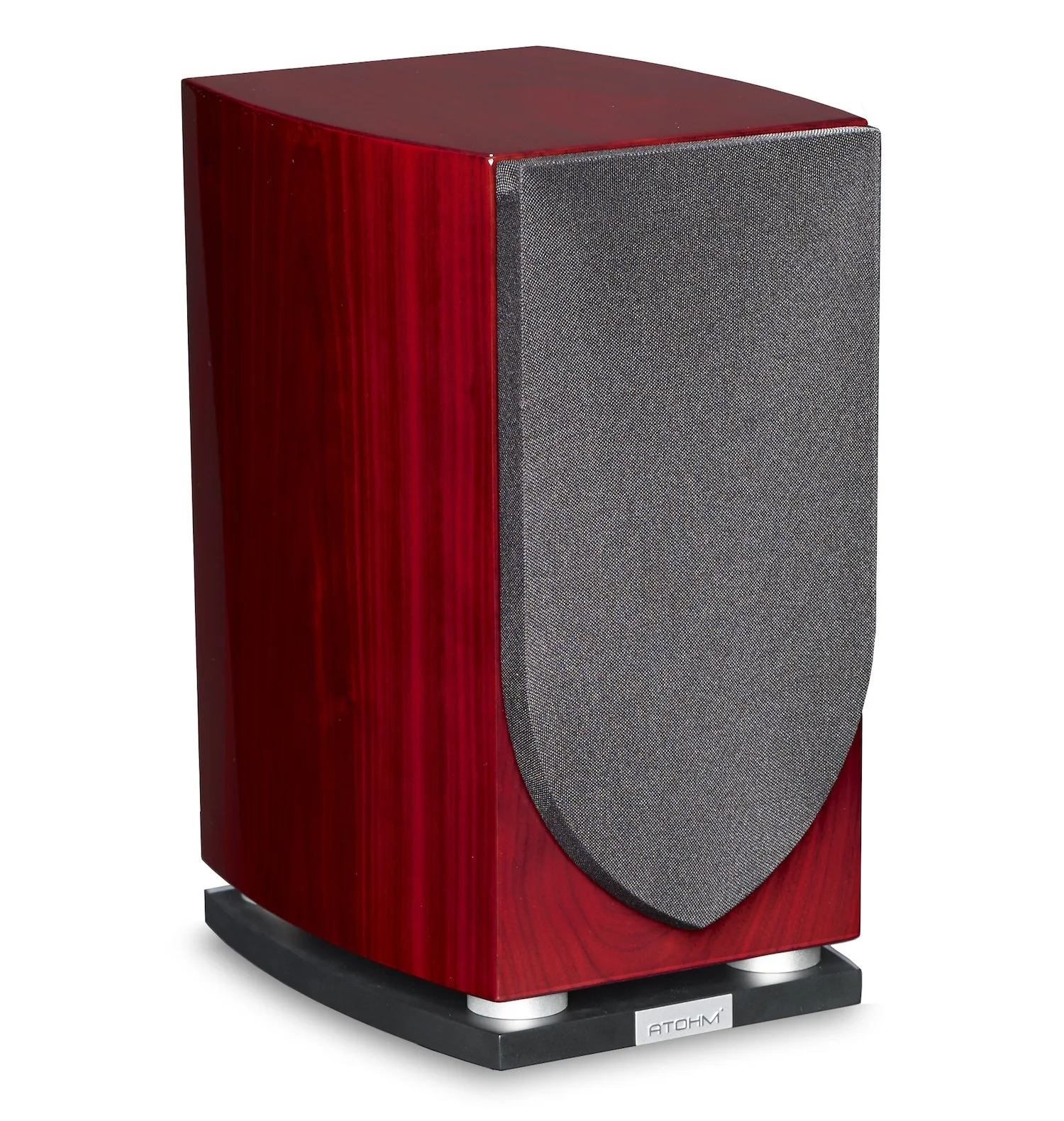
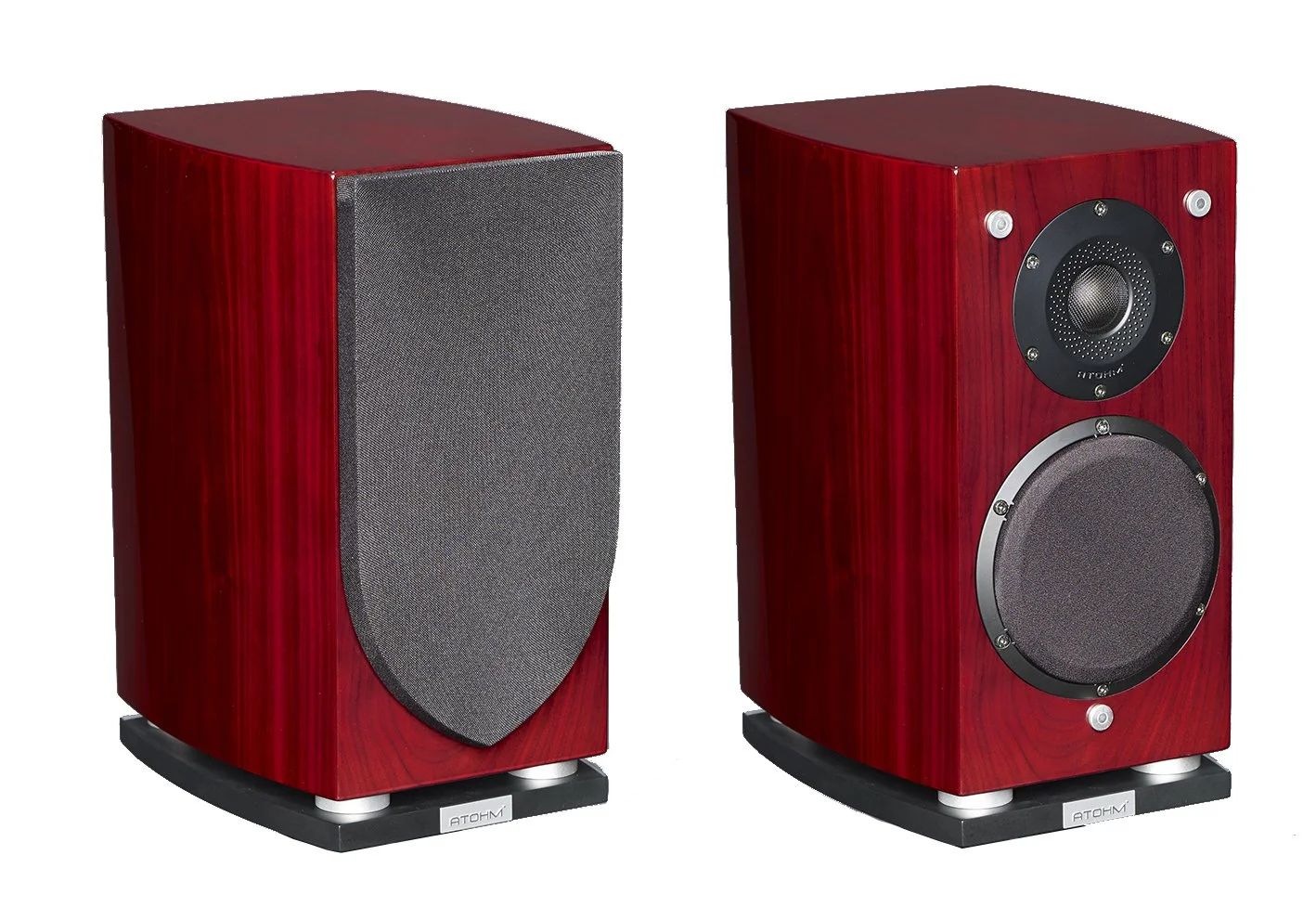
The smallest member of their top GT-Series, the two–way GT1-HD are bottom–ported and time aligned. First launched in 2008, the HD improvements to the GT Series appeared in 2015 at Munich High End. One of the aspects of these speakers that initially attracted me was their wide frequency response. Atohm specs them as 3dB down at 45Hz and 30kHz. Publishing an actual spec with tolerances is commendable, a practice I wish all manufacturers would follow.
Speaking of frequency response, the GT1-HD has a very handy, three position tweeter pad on the back. The user docs label the settings as Smooth, Linear and, a bit disingenuously, HD. The two edge settings insert the equivalent of a high frequency shelf at 2.5kHz for a fixed -2dB (Smooth) or +3dB (HD) of contouring. The Linear setting is flat. More on how this is accomplished in a bit… When I first started listening, I certainly didn’t want additional high frequency energy but, over time, I did end up spending a healthy fraction of my listening time with the switch in the Smooth position. At just under an eight foot on–axis distance from the tweeters, one might think that I was simply receiving a bit more HF than was appropriate. The trouble with that assumption is that, with most loudspeakers, I usually lift the high end about a decibel. The user manual states that the strangely named HD setting is “…ideal for over–damped rooms and/or can be used in combination with electronics which sound dull and are lacking in dynamics.” Dynamics? Not sure where that comes from, but I can say that much modern pop, with it’s penetrating, paper cut high end and crunchy harmonic distortions, benefitted from the Smooth setting. That said, some older listeners with our age–related high frequency loss might appreciate the added top that the HD setting confers.
Emilios Mandalios, the very amiable head of Audio Excellent in Park Ridge IL, suggested that I try a set of 24" Dynaudio Stand 10 supports with the Atohms. These Dyn’ stands are far more evolved than my quotidian Sanus Foundations Steels. The fancy stands not only had tool–free leveling, a well designed wire race and excellent spikes, but they also came with long, thin plastic bags to contain dampening material. As I write this, it is -22°F here in Saint Paul MN, so we know a thing or two about snow and even ICE. Ice, the frozen water variety, requires the mastery of induced friction. When I was setting up the stands, I happened to head off to my local Ace hardware for some fasteners. While in the checkout, I asked about sand to fill the Dynaudios. The helpful clerk instead suggested poultry grit, a substance I had never considered since I don’t maintain any gizzards. He assured me that the grit would not only damp down my stands but also provide better traction than sand for my car. Hot damn, he was so right. Go, #2 poultry grit!
The pair of GT1-HDs that I received had been used prior by a YouTuber, so I assumed they were already burned in. Silly me to consider such an outlandish thought. After initial listening sessions that causes the aforementioned consternation, I noticed that the speakers started to change…in a good way. Thought I, “Maybe the vlogger didn’t actually listen to them,” so I queued up some brown and pink noise and let them cook for a few weeks. Lo and behold, the shouty mid and grating high end had been tamed. “Hey!” I thought, “… these aren’t bad after all!” And so, dear reader, I settled in to enjoy the little beasts and absorb their Gallic messaging.
My initial thoughts were along the lines of low distortion, a bountiful but controlled upper low end, and a forward, pleasantly pushed midrange. After looking at some data sent to me by Thierry Comte, owner, general manager, and designer chez WELCOHM TECHNOLOGY, the corporate parent of ATOHM, I was surprised and delight to see that distortion was indeed well controlled, with 3rd harmonic never exceeding -50dB of suppression above 100Hz. After an extended break–in, I found that these are entertaining little ladies.
Once they're limbered up, I was surprised and excited to find them consistently engaging. The GT1-HD draws you in, making you want to listen more. Not just listening, but head nodding, toe tapping, harmony singin’ involvement. These speakers remind me of a better, more refined version of 1970s California hi–fi or fancier Bowers & Wilkins stand mounters in that they portray midrange with a clear and satisfying heft. Not bloat, just a big, full delicious sound. That same midrange and high end are clean, clean, clean. Unsullied as in well under 0.3% THD (total harmonic distortion) from 700Hz to 7kHz. This is accomplished, in part, by using a well understood design approach; utilize all parts well inside their safe operating limits. By avoiding any whiff of boundary conditions, what Comte refers to as “within the controlled margin,” the drivers stay within a linear, low distortion regime. Here’s part of a lengthy e–mail discourse from Conte. “As you certainly know, tweeters do not have the same thermal power handling than mid bass units. Tweeter power handling is quite low… Thus, if both drivers and tweeter have the same efficiency, power compression doesn’t occur at the same level. In order to get exactly the same uniform dynamic possibilities from 100Hz - 20kHz on a finalized speaker, we designed a very high efficiency tweeter (the 98dB /2.83V @1m ATOHM SD28ND04RD). This tweeter is then attenuated by 6 to 11dB, depending on the back panel knob adjustment, to fit the mid bass efficiency. By doing this, it means the tweeter is not working at the same power as the mid bass. (This means that)… the power compression is occurring at the same level and is matched for both drive units for a full range of reproduction. In addition, as the tweeter is used at lower power, several kinds of distortion are greatly reduced. It is also explains why 99.5% of our tweeters that had been mounted in the last 18 years are still alive! Believes me, sometimes the speakers are really abused by customers!! Thanks to the huge neodymium ring (magnet), the motor reaches very high flux into its gap (1.9Tesla). This strong value not only creates the high efficiency of this tweeter but also decreases in significant proportion the flux modulation and coil inductance variations, which are responsible for some significant distortions.”

Let’s do some listening…When Your Time Comes [Qobuz 96k Tiny Tiger Records 2026] from Tessa Rose Jackson’s new album The Lighthouse pulls me in all the right directions. Of the album, Minnesota native Jackson wrote, “this family home happens to be right next to a village graveyard and the January air was foggy and crisp and brilliantly spooky.” Indeed. Myriad textural elements, including treated samples, percussion, strummed guitars and breathy background vocals, are all rendered without strain or confusion by the GT1-HDs. I’m a sucker for doubled vocals and the artist, along with her producer Darius Timmer tuck in extra ear candy throughout the album.
I mentioned fatness earlier, and the ATOHMs low end is one area of particular delight. For a two–way, stand mounted speaker, the GT1-HD delivers on the essential foundational bed of music. In my room all by themselves, the pretty little gals gave a very usable 36Hz, well below the factory–specified 45Hz. That said, I did try adding my KEF KC62 subcompact subwoofer to the mix. To that pairing I say, “Excellent!” in my best Bill & Ted voice. Most folks still think that subwoofers are ①; meant only for the LFE or Low Frequency Effects channel, and ②; their contribution should be “heard” as in “Wow, listen to all that bass!” Both concepts, dear reader, are dead wrong. A “sub” should be noticed only when it’s turned off mid–playback, eliciting “What happened to the low end?” dismay. If you know a sub is in play, then it’s too loud. As to the first point, a high quality, low distortion subwoofer adds a healthy dose of verisimilitude. It not only props up a smaller speaker’s natural LF rolloff, it subjectively augments the lower mid even though subs, especially mono subs, should not be operated above about 80Hz to discourage localization. You should not be able to locate a sub as a source of sound. If you can it’s again too loud or operating at too high a frequency. Giant subs are really for show, as it only takes a touch of energy in the 20-80Hz range to wake things up and blend with even a small speaker.

While in the fatness vein, I turned to guitarist Julian Lage’s Talking Drum off his 2026 release, Scenes From Above [Qobuz 96k Blue Note Records]. This song showcases a well recorded jazz combo in action. John Medeski’s organ sits prominently in the mix, yet Jorge Roeder’s upright bass holds up the piece while Kenny Wollesen’s trap kit propels the proceedings along. Through the ATOHMs, everyone is given equal pride of place.
Let’s talk more about subjective experience. Rock Me on the Water from a lovely retrospective of Linda Ronstadt called The Early Years [Qobuz 192k Rhino 2026] is only one of fifteen beautiful, higher resolution tracks. Through the GT1-HDs, Ms. Ronstadt’s voice was thrilling, while all the remaining mix elements sat nicely in their pockets. With a careful listen, you can hear the differing production techniques each song brings, which speaks to the mastering engineer’s skill and ability to united disparate sources.

Eric Bibb’s Didn’t I Keep Runnin’ from One Mississippi (Qobuz 96k Repute Records 2026] has Bibb’s vocal either EQ’d, processed or recorded through possibly a U87 condenser microphone to accentuate his vocal fry. The U87 is a popular mic and one of my least favorites for its penetrating peakiness. Through many speakers, that extra energy would drive me screaming from the room. Not so the shapely French demoiselles. Crunchy though the production may be, the speakers conveyed an agreeable sense of proportion. As with all the songs I mention in each review, I recommend you sample each album as you might discover a new favorite. During my writing of this piece, I was working my way through Qobuz’s new release recommendations. I really love their curation, it certainly speaks to me and my predilections. Nova Scotian artist Lance Sampson, stage name Aquakultre, is at once quirky, sincere, nostalgic, and of the moment. His concept album, 1783 [Qobuz 96k Next Door Records 2026], revolves around a swirl of threads related to the end of our hard–fought War of Independence. Matriarchs is a rousing piece that honors the strong women who have our back and keep us all on track. This is a big song, a raucous piece of R&B and soul that wraps up with a gospel finish. I played it LOUD, and the GT1-HDs shrugged it off without altering the timbre or balance.
Atom has been in business since 2000. Comte built his first DIY speaker at the tender age of 12. He cut his adult teeth at Triangle Electroacoustic. With the GT1-HDs, Comte has crafted a wonderful small speaker. Its wide frequency response, low distortion and exquisite cabinetry are appreciated, and its three-position tweeter pad offers welcome flexibility in subjective tuning. All in all, a compelling package well worth your attention.
WELCOHM TECHNOLOGY
Pin FR 70150
www.atohm.com
GT1-HD — $4495 pair
THE COMPANY
WELCOHM TECHNOLOGY
Pin FR 70150
www.atohm.com
GT1-HD — $4495 pair