MCINTOSH C8 PREAMPLIFIER - REVIEW
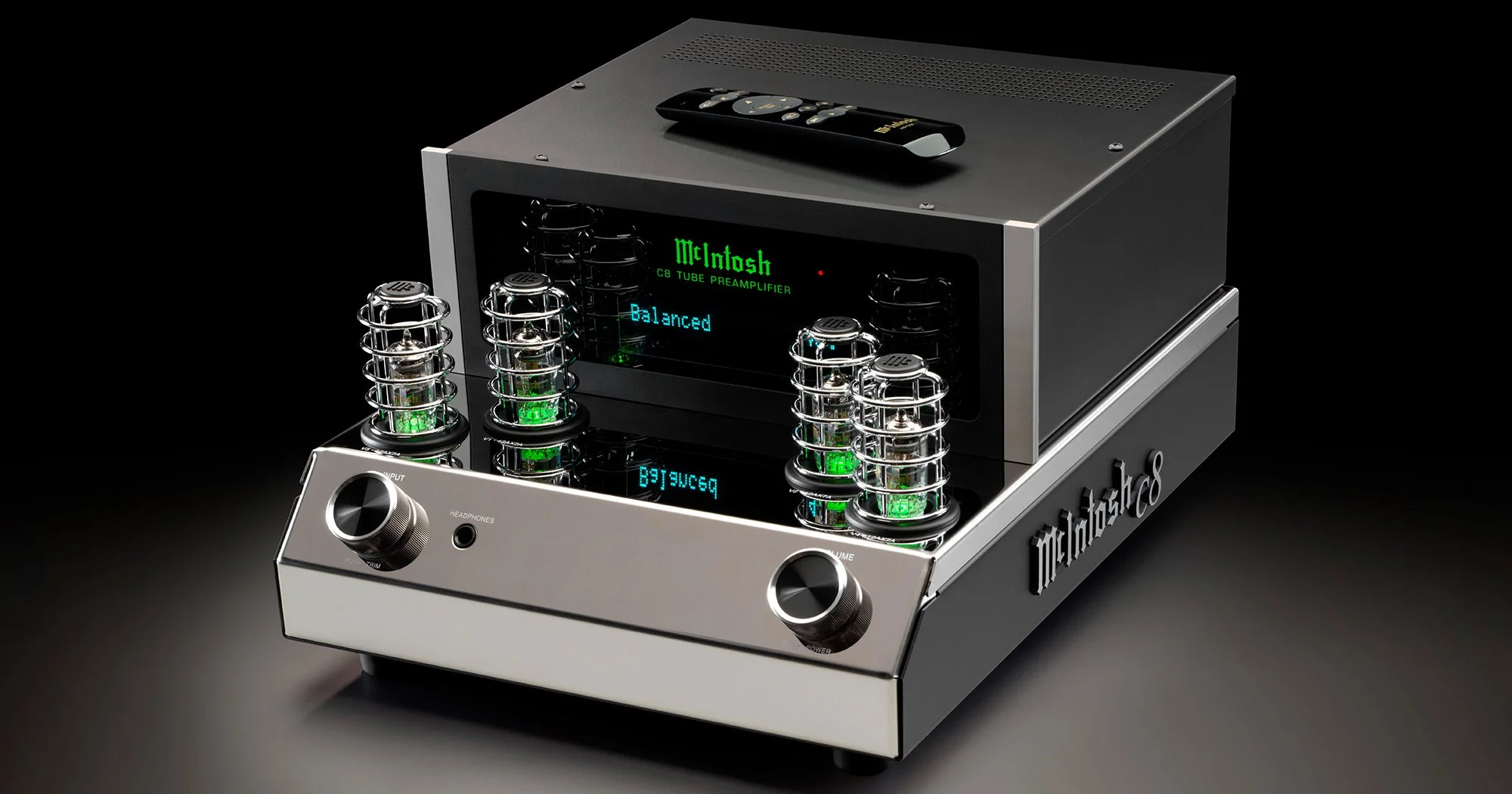
McIntosh C8 vacuum tube Preamplifier - REVIEW
Making a success of any consumer electronics venture is an exceedingly hard thing to do. The high-end audio industry roots out incompetence and mediocrity with a ruthless vengeance. Very few audiophile OEMs reach their tenth anniversary. Founded by Frank McIntosh in 1949, McIntosh Labs™ has now been in business for 75 years(!). No, that’s not a misprint. Today, in 2024, McIntosh has been manufacturing ultra high-end audio gear for 75 glorious years.
When the opportunity to review McIntosh’s C8 vacuum tube pre-amplifier ($4,000 USD MSRP) arose, I was more excited than a racoon on a caffeine bender that’d tunnelled its way into a bakery and landed upon a fresh batch of warm peanut-butter cookies.
Product description
The C8 tube pre-amplifier is a two-channel model that uses 4 x 12AX7a vacuum tubes. The front of the C8 features two knobs: the left side knob is for selecting inputs; the right side knob is a volume control that can also be used to scroll through input values when the set-up or trim modes are selected. There’s also a ¼” headphone output jack for headphone listening. Headphones are NOT included.
The C8’s front panel has a Vacuum Fluorescent Display (VFD) for set-up and monitoring. The unit’s striking industrial design boldly embraces McIntosh’s proud heritage with a classic yet modern aesthetic.
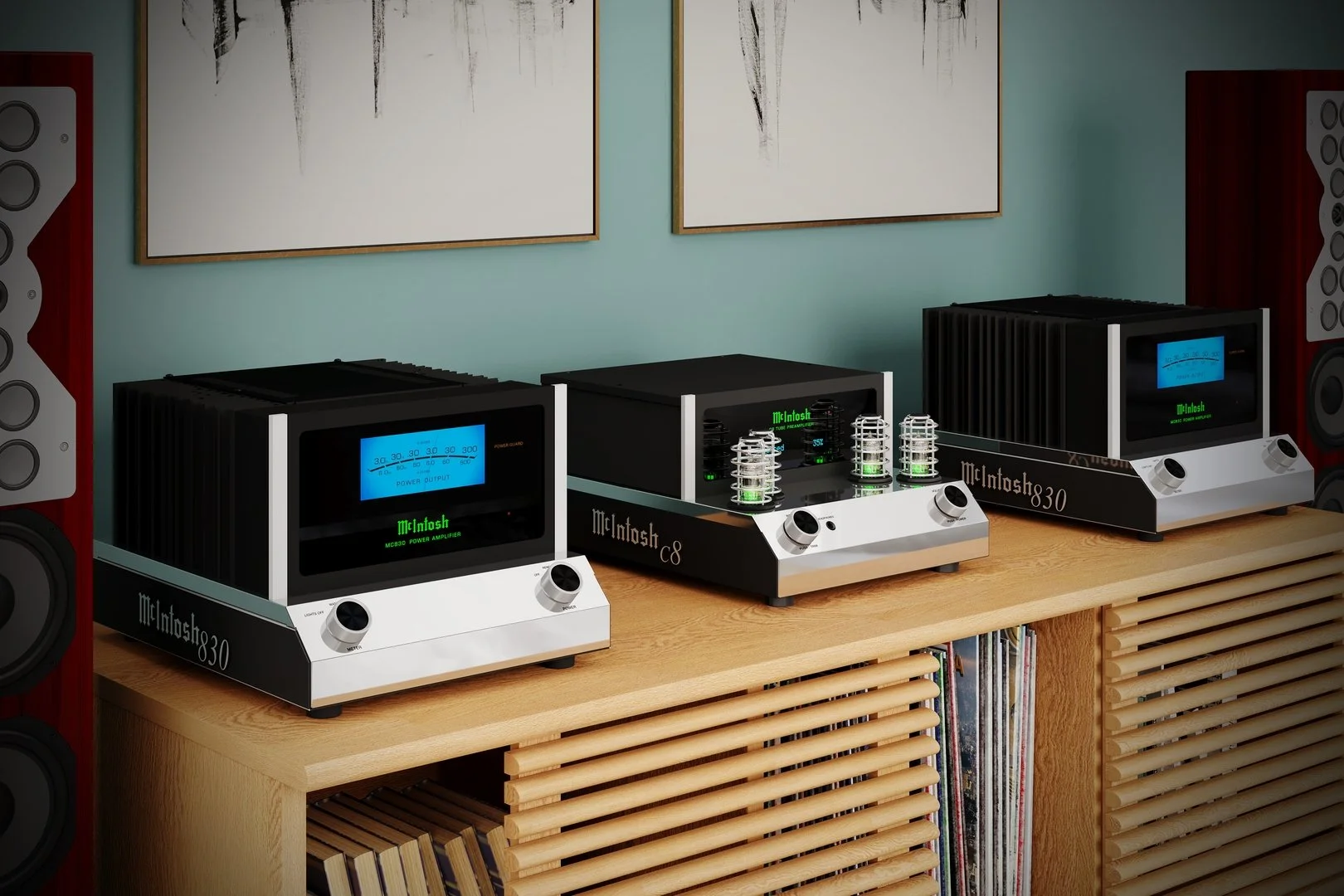
The C8 is targeted to budding audiophiles who’ve (probably) owned a sub-$2,000 USD integrated amplifier and who’d like to climb higher up the sonic ladder to a multi-component stereo system. McIntosh designed the C8 to mate with a pair of their single-channel MC830 solid state mono-block amplifiers.
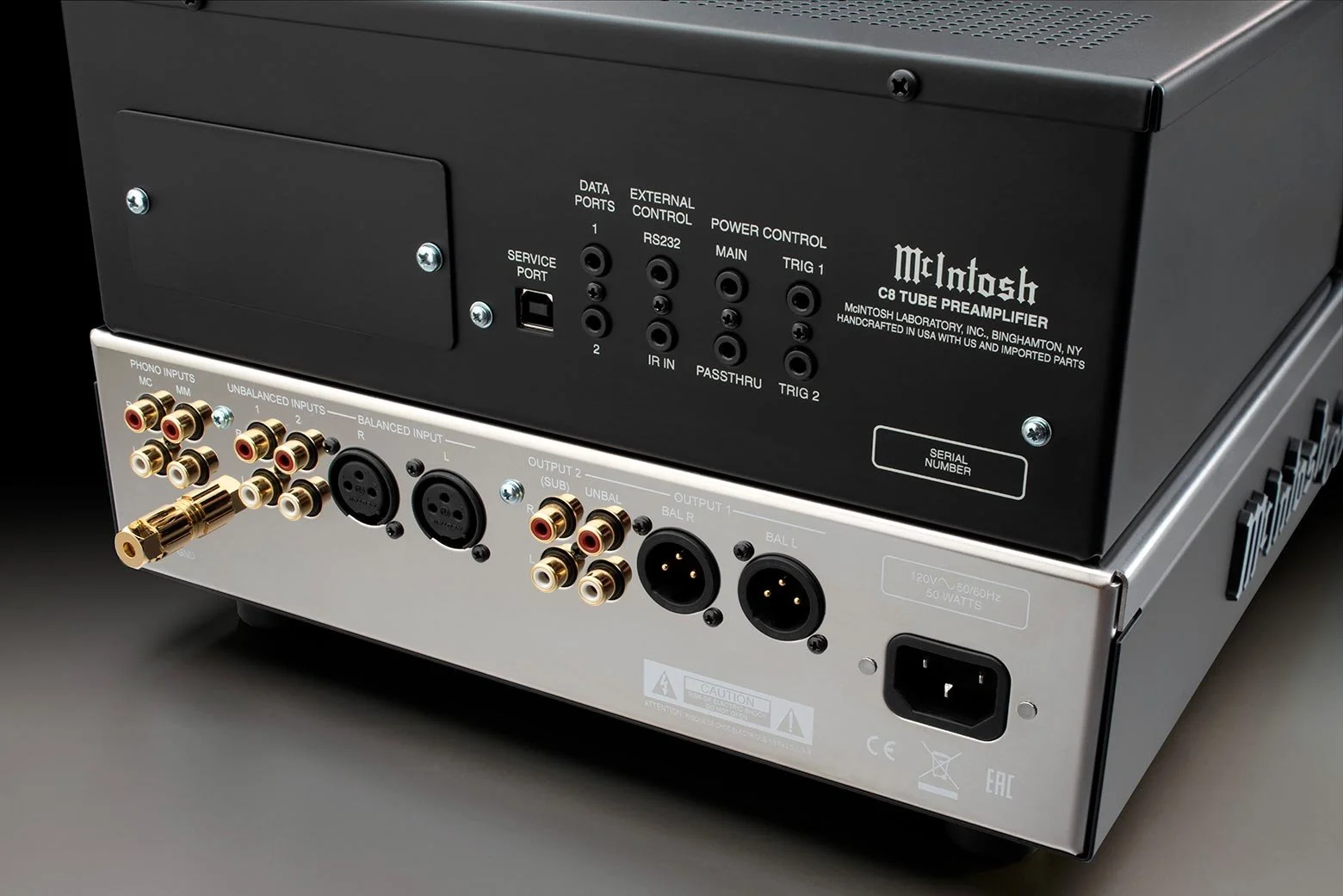
The rear of the C8 has five analog inputs. These include a pair of XLR (left and right channel) balanced inputs; two pairs of single-ended (unbalanced) RCA inputs; and two pairs of RCA Phono inputs—one pair for moving coil (M/C) cartridges and a second pair for moving magnet (M/M) cartridges.
The C8 has two pairs of single-ended (i.e. unbalanced) RCA outputs and one pair of balanced 3-pin XLR outputs. The unit also comes with a three-prong male IEC plug so that the supplied A/C power cord can be upgraded. A binding post is included if a user wishes to connect the C8 to an isolated grounding system. The pre-amp also comes with a remote control.
Custom integrators will delight in finding an array of triggers and control ports. The unit even offers a user-selectable auto off switch that automatically turns the C8 off after 30 minutes if no incoming audio signal is detected. This is (obviously) designed to extend the lifespan of the vacuum tubes.
The C8’s dimensions are 31.2 cm (12+9/32”) wide; 19.4cm (7⅝”) high; and 41.3cm (16¼”) deep. Unboxed, the unit weighs 18 pounds. Given its small dimensions and sensible weight, the C8 could be THE solution for audiophiles looking for a tube pre-amp for a desk-top headphone system for the cottage or at work.
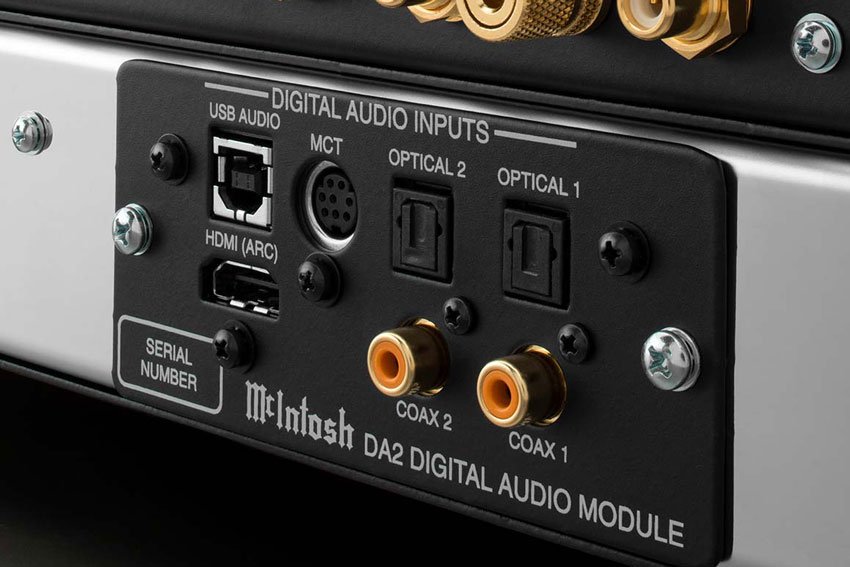
Users can order McIntosh’s custom DA2 Digital Audio Module upgrade board ($1,200 USD). This optional digital module features a quad balanced 8-ch 32-bit DAC.
My review unit did NOT come with this DA2 module installed. Therefore, I cannot comment on the sound quality of the optional DAC.
The C8 offers everything 99% of audiophiles would need in a tube pre-amplifier. One of the single-ended RCA outputs can be configured as a subwoofer output.
Initial set-up of the C8 pre-amp
I swapped the C8 in for my Audio Research LS-28 SE tube pre-amp in my $180K-level Esoteric and Sonus faber two-channel rig. The C8 sounded its best when powered with a 1.5m Rick Schultz Audio™ Apparition 15 Amp A/C cord.
Squeezing this much sound out of any high-end tube pre-amplifier usually requires upgrading the supplied vacuum tubes with exotic NOS (New Old Stock) valves. Although tube rolling was FAR beyond the scope of this article, an end-user might want to call or email McIntosh’s tech support department for their advice on possibly upgrading the tubes.
Intrinsic sonic impressions + comparison tests
The C8 has bass and treble (i.e. tone) controls. Accordingly, the sound quality can be adjusted to better sync with room acoustics. For my listening tests, I set these tone control levels to a flat zero position.
C8 vs. McIntosh’s C22 tube pre-amplifier
I first compared the $4,000 USD C8 to McIntosh’s $6,000 USD C22 tube pre-amplifier. The C8 definitely has McIntosh’s tube-DNA in its blood. Midrange vocals were warm, smooth, and rich. The C22 has a much bigger power supply. A better power supply usually results in superior sonics.
Soundstage size between the C8 and the C22 was similar. The C22 did, however, create better image placement and separation of individual instruments within the soundstage. In terms of imaging, the C22 delineated individual instruments with about 20% more precision than the C8.
In my two-channel system, the C22 offered deeper resolution and slightly faster transients. The C8’s sound quality was a lot closer to the C22’s sonics than I expected it to be. The C8 has the same velvety smoothness and tactile texturing that the C22 delivers. It’s just that the C8 doesn’t offer as much of it.
I tried both RCA phono inputs with a heavily modified Rega P-25 turntable, RB-600 tonearm, and various M/M and M/C cartridges. The sound quality was surprisingly coherent and musical. Although the sonics won’t compete with stand-alone tube phono stages priced north of the $2,000 USD retail price point, the sound quality of the C8’s M/M and M/C phono stages sits in the $1,000 USD to $1,200 USD retail price range.
I also compared McIntosh’s C8 to the following tube pre-amplifiers: a) an ARC LS-28 SE ($10,000 USD); b) an ARC Reference-6 SE ($17,000 USD); c) a heavily modified Sonic Frontiers Line-3 SE ($14,000 CAD); and d) a First Sound™ Presence Deluxe 4.0 Mk#2 Special Edition ($9,000 USD) hot-rodded with a pair of NOS Siemens-Halske 7308 gold pin tubes.
The C8 won’t get a listener to the last 5% of what’s currently available from pre-amps in terms of bass extension, low-level detail retrieval, soundstage width and depth, and overall sonic coherency. The C8 simply does not have the resolution or incisiveness of tweaked-out tube pre-amps that can be found north of the $10K USD retail price point.
To be fair, the C8 wasn’t designed to climb to the highest sonic peaks that current vacuum tube pre-amps are capable of ascending to. McIntosh is trying to offer new(er) audiophiles a taste of the sound quality that their flagship C12000 tube pre-amp (MSRP $12,000 USD) delivers. At one-third of the C12000’s retail price, the C8 achieves this goal.
The C8 reminded me—fondly—of affordable tube pre-amps from the mid-1990s. And yet, the C8 creates faster dynamics, a much lower noise floor, and a coherent sound that isn’t as syrupy or overly romantic as tube pre-amps from 30 years ago. The vast majority of music lovers will neither need nor want to climb any higher up the sonic ladder into five-figure vacuum tube sound.
Listening tests
I started with the Rolling Stones’ 2016 album Blue & Lonesome [Polydor: 5714942] on Redbook CD.
Featuring tracks like “All of Your Love,” “Hoo Doo Blues,” and “I Gotta Go,” Lonesome won a Grammy™ for Best Traditional Blues Album in 2018. The Stones’ 23rd studio album, the record showcases cover songs of blues tracks. Engineered by studio czar Don Was, the recording has stellar sonics that take a listener on a deep dive into blues classics.
What I noticed immediately with the C8 tube pre-amp directing things was how cohesive and musical Lonesome sounded. There are a million ways to cripple the sound quality of a high-resolution blues recording like this one. What the C8 delivered—in spades—was a flow and musicality to the songs that was a joy to hear.
I next listened to Rossini: Overtures/Sinfonie Norrington [EMI Digital: CDC 554091].
Featuring memorable tracks like “Il Barbiere di Siviglia,” “La gazza Iadra,” and “Guillame Tell,” this album is one of my go-to recordings for testing any component’s ability to reproduce PRaT, soundstaging, and dynamics. The brutal shifts in the orchestra’s movements go from subtle, delicate, and serene to caffeinated and explosive at neck-snapping speed. If a tube pre-amp can’t accurately replicate gunshot dynamics heard across a huge soundstage, this recording will expose that sonic flaw in record time.
As the Barber of Seville transitions through the Andante maestoso, Allegro con brio, and final Più mosso sections, the song builds and builds, and then crescendos into a freakin’ musical explosion. It’s the cannon-blast sonic assault in this Overture that at times has the entire orchestra playing at warp-speeds that practically fracture the space-time continuum. Looking for some calming music to soothe your jangled nerves? Look elsewhere. This is the kind of orchestral onslaught that an air-cavalry helicopter squadron should blast at max watts when blitzkrieging into enemy territory.
The C8 pre-amp did a wonderful job of reproducing the shivering espresso-fuelled dynamic energy of Rossini’s rampaging Overtures. Far too many cheap(ish) pre-amps that I’ve heard down through the decades completely fail to recreate the complex PRaT and booming percussive assaults in these songs. Not so with the C8 in play.
Conclusion
If I were starting over and didn’t already own several reference-calibre valve pre-amps, McIntosh’s $4,000 USD C8 is THE vacuum tube pre-amplifier I’d buy. For those who are new to high-end audio and have a sub-$5,000 USD budget for a tube pre-amp, the C8 is the first unit I’d recommend they audition. Only a very small percentage of audio-nutters will ever need—or want—a more expensive pre-amplifier than McIntosh’s C8. Heartily recommended!