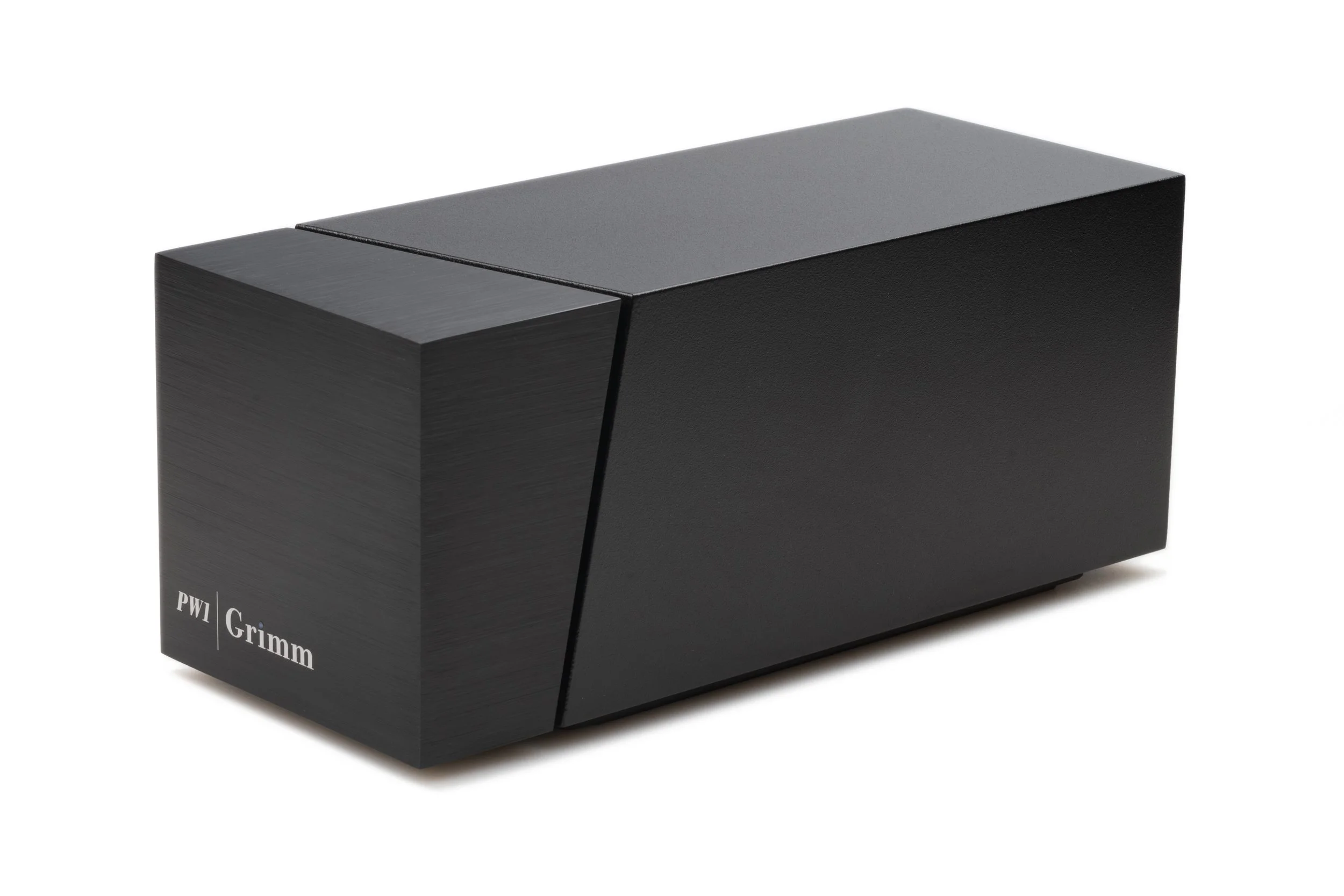
GRIMM AUDIO PW1 PHONO PREAMPLIFIER
Grimm Audio, based in The Netherlands, has built a reputation for precision engineering and exceptional sound quality, particularly in the realm of digital audio. With products like the MU2 preamp/DAC/streamer, the MU1 streamer, and LS1 playback system, the company has demonstrated an ability to push the boundaries of high resolution digital playback. One listen to a system with Grimm based sources will make this abundantly clear.
Grimm also made a name for themselves in the world of professional audio, with their Analog To Digital converters used by world class discerning engineers to master recordings in high resolution PCM and DSD. I’ve been told by several industry professionals that Grimm ADC’s are second to none. Grimm also makes master clocks, cables, and loudspeakers. Interestingly, they also made a bespoke power supply for high end tube based and vintage microphones. Their professional products are not inexpensive, but are state of the art.
With the release of their first-ever phono preamplifier, the PW1, Grimm is making a bold statement: Analog and digital are two sides of the same coin! The PW1 was announced at the end of last year and retails for $4900. As surprising as this product is, apparently, Grimm Audio’s roots run deep in the world of vinyl.
According to Creative Director Eelco Grimm, the company’s founders were deeply inspired by vinyl decades ago. This inspiration led them to dedicate their time to developing high performance audio equipment. Even in an era dominated by high end digital systems, Grimm acknowledges that vinyl remains magical. The PW1 was conceived as part of their vision to build the full analog signal chain, ensuring that vinyl lovers have access to a reference-level phono stage. But to be worthy of the Grimm Audio name, it had to be something truly special.
The PW1 is named after its chief designer, Peter van Willenswaard, one of Grimm Audio’s co-founders. Peter has spent his professional career designing, analyzing, and refining phono preamplifiers, working with both solid-state and tube-based designs. He understands, after a lifetime of experience in all stages in the amplification chain, that the phono preamplifier presents the greatest engineering challenge. One of the main reasons for this is that Moving Coil cartridges output incredibly small signal levels.
To put it in perspective: A deep bass signal from an MC cartridge may be as low as 50 nV (nanovolts).To bring this signal up to line level, the preamp must provide a whopping 90 dB of amplification.This means the PW1, and every phono stage, must handle microscopic electrical signals while remaining dead silent, preserving every nuance without introducing noise or distortion. You can imagine there is a lot that can interfere with this task.

Minimalist Design, Maximum Performance
Grimm Audio says that Van Willenswaard’s FET based phono stage matches the warmth and musicality of his best tube designs, an impressive claim about the often-debated sonic differences between solid-state and tube amplification. Having reviewed tube based phono preamps in the past, there is no doubt about the bloom and harmonic richness they produce, possibly at the cost of slightly higher signal to noise. To achieve this, Van Willenswaard followed a purist design philosophy.
This approach was achieved by using minimal active components, with only the most essential transistors and circuitry to preserve the signal integrity. Each part was hand selected, and each component was carefully chosen for its electrical and sonic performance. Optimized circuit layouts were used with the goal of ultra low noise, low distortion, and a wide dynamic range Finally, there was a goal of dispensing with unnecessary complexity.
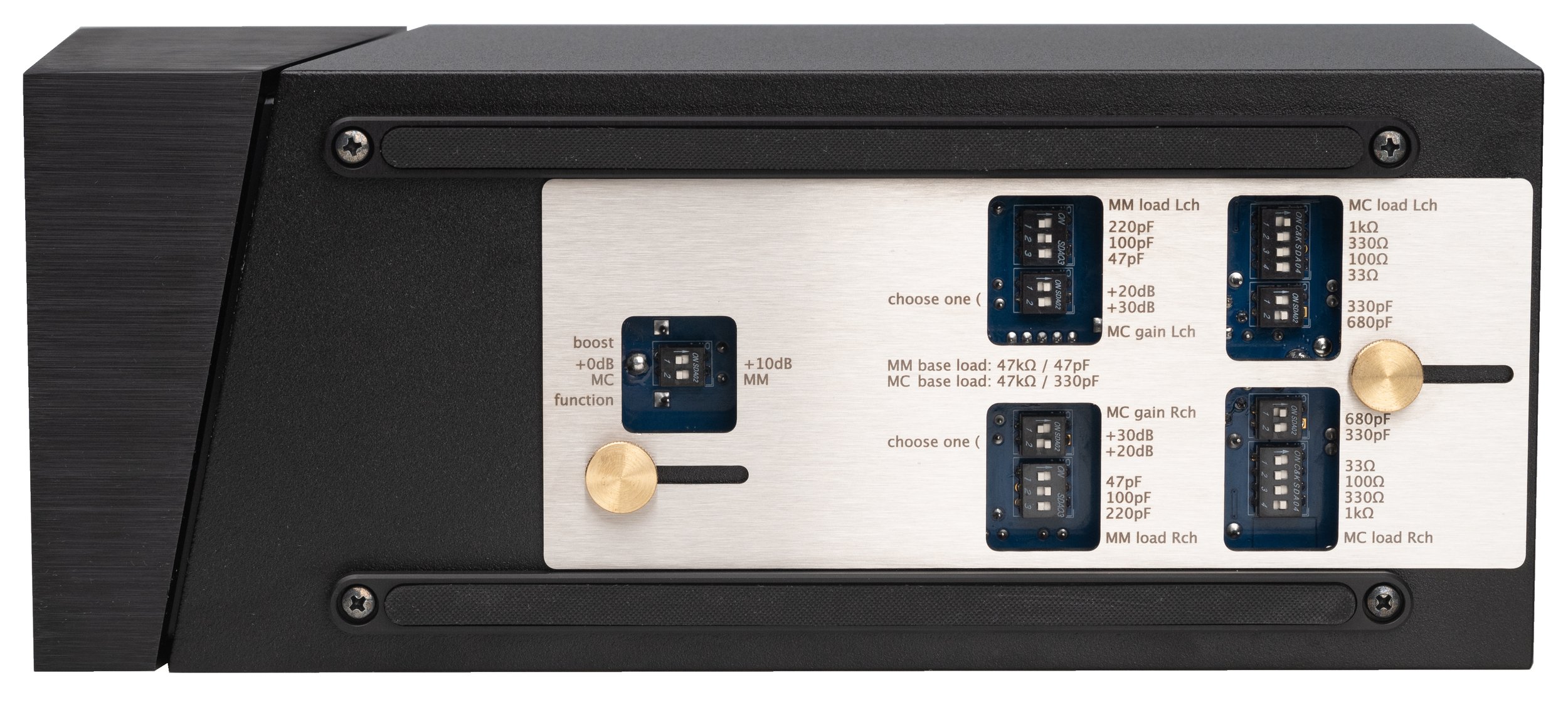
An overview of the nuts and bolts gives us RCA inputs for both Moving Coil and Moving Magnet carriages. There are RCA and XLR outputs, and an IEC inlet. Grimm says the internal power supply is shielded in such a superior way, there is no need for an external PSU. Lastly, there is a slide away panel underneath the PW1 with DIP switches to make custom adjustments for MM and MC cartridges. A handy tool is provided for easy toggling of the switches. The whole thing is an elegant, rectangular shaped box, and the quality of the fit and finish is first class.
Set Up & Listening:
The Grimm PW1 was used with three different turntables. These included a Rega Planar 8 with Ania cartridge, a SOTA Comet IV with an Audio Technica AT-33s carriage, and the heavy hitting Transrotor Bellini table with an Accuphase AC-6 cartridge. The Transrotor / Accuphase combination will be getting a full review. The rest of the system consisted of A Rogue RP5 preamp, a SIM Audio 761 power amplifier, Magnepan 3.7i speakers, and Clarus cables.

We started off with an LP we had used to review numerous turntables and their peripherals, namely Joan Baez’s 1970 masterwork, One Day At A Time, on the Vanguard label. After several spins of both sides, the descriptors that came to mind were Natural, Spacious, and Addictive
We heard aspects of the mix we honestly had never perceived as accurately. For example, the reverb tails on the snare drum, the distinct sonic space that the dobros, lap steels, and acoustic guitars inhabited was so accurately framed, it was thrilling. Baez’s fantastic version of the Rolling Stones’s “No Expectations” was a stunner through the PW1, and especially with the Transrotor table.

An original Columbia pressing of The Byrds Greatest Hits really came to life with the Grimm. The jangle and ring of the Rickenbacker guitars, the harmonies of David Crosby, Roger McGuinn, and Gene Clark were nothing short of angelic. The production values common to Columbia studios, including the trademark reverbs, hard stereo panning, and overall even balance were shown in the best possible light. The Dylan classics “Mr. Tambourine Man” and “All I Really Want To Do” were a goosebump inducing time capsule

Fast forwarding to the 21st century, we were really surprised how much we enjoyed the vinyl remaster of U2’s All That You Can’t Leave Behind, originally released in 2000. It was likely either tracked or mixed digitally, but Bernie Grundman’s vinyl cut is nothing short of superb. The guitars sizzle, the bass and drums have excellent impact, and Bono’s lead vocals are rendered on a scale not heard on the original CD.
The tracks “Walk On’, and “New York” have tension and release and the dynamics were explosive through the Grimm, as it seemed to get inside and out of the way of the music. Our favorite track, “Elevation” brings the band's punk and new wave roots to the forefront with an arena ready sing along chorus and fuzzed out guitars. The PW1 shone a light on how crafty the band’s interplay can be, and the texture was “reach out and touch it”.
A summary of the overall performance and character of the Grimm PW1 Is not easy, as it seems not to have a “sound”. However, the soundstage is wide and deep, with a sense of air and realism. It was detailed and open. Every micro and macro detail is revealed effortlessly, yet never harsh, unless the pressing has that encoded in the grooves
Other descriptors that come to mind, over the course of many listening sessions, are rhythmically addictive, and highly Involving, It doesn’t just reproduce sound, it draws you into the music. One of the most significant accomplishments of the PW1 is that it disappears into the system. Instead of making you aware that you’re listening to a” highly sophisticated” phono stage,
For those who have spent time comparing tube vs. solid-state phono stages, the PW1 brings the best of both worlds: The richness and texture of tubes, and the clarity and control of solid-state The effortless musicality that vinyl folks live for is there in spades.
The PW1 isn’t just about sound quality, it’s also incredibly versatile. Grimm Audio ensured that it can accommodate a wide range of cartridges, thanks to adjustable loading settings via the cleverly situated panel on the bottom of the unit. This thoughtful design keeps the front panel clean while allowing audiophiles to fine tune the impedance and capacitance, and gain for optimal performance. We were able to dial in the best settings for three separate cartridges effortlessly.
This compact, integrated design makes the PW1 more convenient while purporting to maintain the same level of performance as external power supply designs. While Grimm Audio has been widely celebrated for their digital innovations, the PW1 marks their growing commitment to analog.
Conclusion:
The Grimm Audio PW1 is a new reference for us in phono stages under $10,000. It simply checks every box imaginable. Its virtues are many, and its flaws are nonexistent to these ears. Superb transparency and spaciousness, and a perfect balance between tube-like warmth and solid-state clarity are it’s calling cards.
In addition, Grimm seems to have nailed their goal of low noise performance, even with the lowest-output MC cartridges,The minimalist design includes a power supply so quiet it doesn’t need an external chassis. For those looking for the ultimate phono stage, without spending a small fortune, one that reveals the full potential of their turntable and cartridge, the PW1 is a top tier contender. Grimm Audio has once again delivered a masterpiece, proving that whether in digital or analog, their mission remains the same:
“Creating audio equipment that makes you forget about technology and simply fall in love with the music seems a noble goal, but it is one that is not easy to achieve. This less-is-more approach is part of what makes the PW1 so appealing. Rather than brute force engineering, Grimm Audio seems to have opted for balance, and purity, a choice that pays off in the final analysis.”
Product Information:
Grimm Audio PW1 Phono Preamplifier: $4900
MC and MM cartridge inputs
RCA and XLR outputs
Gain and load settings under bottom plate
Internal silent linear power supply
Copper shielded interior
100 x 100 x 250mm (WxHxD)
5 year limited warranty
THE COMPANY
Grimm Audio BV
Zandven 6
5508 RN Veldhoven
The Netherlands
VAT: NL858297978.B01
info@grimmaudio.com
+31 40 213 1562