ATMA-SPHERE MP-3 PREAMPLIFIER & CLASS D AMPLIFIERS - REVIEW

ATMA-SPHERE MP-3 PREAMPLIFIER & CLASS D AMPLIFIERS
I’ve gotten to know Ralph Karsten at Atma-Sphere over the course of the past year and it’s been both very informative, Ralph knows a great deal, and it’s been fun. I’ve also gotten to know Adam Marx, who has worked with Ralph for over 25 years. It has also been very nice to talk with and to get to know him as well. In truth, I enjoy visiting them.
My first experience with an Atma-Sphere product was the GEM, a five-watt integrated that literally fits on your palm or my palm. It was a revelation first as a headphone amplifier, which I adapted to purpose and then as an integrated. I had to wait on the integrated review, as I needed an efficient speaker in-house that would accommodate it. That speaker was the DeVore Fidelity Orangutan O/96 and they had, by-and-large, a very good working relationship.
I also got the difference, as explained by Ralph, of working to a formula and working to deliver what the market would bear. Ralph’s amplifiers proved intrinsic or a real world example of the above.
In short, working to a formula is to develop a product, cost it out, and then formulaically price the product. This is why Ralph’s MP-3 Preamplifier and his Class D monoblocks together cost less than a good deal of integrated amplifiers and a fraction of what comparable separates cost. Developing to what the market would bear, on the other hand, is demonstrated by stratospherically priced components that are demonstrably unaffordable even for most of those who are gainfully employed. This difference, however, became even more stark, when I had the opportunity to evaluate and review the Atma-Sphere MP-3 Preamplifier and the Class D monoblocks. And I have to tell you, there’s no going back from there.
REFRAIN: Unlike most reviews, this review will be non-sequential, as it will start with how the component actually sounds and not the process of physically “undressing” it and/or laying out its various parts, specifications, etc. Think of this review, then, as a non-linear movie—Memento, Kill Bill, Arrival, Eternal Sunshine of the Spotless Mind, etc.—that likewise starts at the end and winds its way to the beginning.
The System - Reference Two Channel
Grimm Audio MU2 Streamer/DAC/Preamplifier
Silent Angel Bonn Pro8 Network Switch
Atma-Sphere MP-3 Preamplifier
Atma-Sphere S-30 Stereo Amplifier
Atma-Sphere CLASS D Monoblock Amplifiers
TRAFORMATIC RHAPSODY 300B Single-Ended Integrated
LYRIC Ti 100 Single-Ended Integrated
Devore Audio Orangutan 0/96
Fern & Roby Raven III Speakers
Kubala-Sosna Realization Interconnects, Speaker Cables, Power cords
Grimm Audio SQM Interconnects (XLR, RCA)
RSX BEYOND, MAX Power-cords
SEISMION Amplifier Stand (powered)
TORUS AUDIO Power conditioner
The Sound
Analog is assuredly in the Atma-Sphere MP-3 and CLASS D’s DNA, there’s just no other way about it. Going from any other tube integrated or separates, this hybrid tubed/Class D amplifier combo presents an ‘analog-ease’ that most others simply can’t match. Further, its technical bonafides are beyond all others and even my reference Lyric Audio Ti 100 MkII, which had itself defeated a number of high-priced giants. And yes, the Ti 100 MkII is very good, however, as compared to the Atma-Sphere hybrid combo, it is as if the Ti 100 MkII were standing still. There could not be a more stark difference in their respective voices.
“The MP-3 extracts more ambient information with greater image specificity, bass definition and dynamic range than any single-ended preamplifier, owing to its patented direct-coupled output.”
—Atma-Sphere
I’ve often commented on a manufacture’s marketing message across their websites or in their marketing materials. Seldom is it ever accurate, though there are those wherein the accuracy is spot on. The marketing quote above puts paid to the MP-3’s ability to sort images with a specificity, an in-room presence, a palpable density, and layering that is impossible to believe. And no single-ended amplifier, to date, has matched this hybrid combo. I sat for a long while after an album had ended shaking my head in disbelief. This Atma-Sphere MP-3 and CLASS D hybrid combo ($12,550) $2,500 more than the Lyric had left my former reference integrated at the starting gate. That said, the Lyric Ti 100 MkII ($9,995) stood at the starting gate in good company among integrateds and tubed and solid state separates. And the least of them was nearly double the cost of the Atma-Sphere combo, while the most expensive was over three times its cost! All were easily seen in the Atma-Sphere combo’s rearview mirror. Yes, this was, indeed, a revelation.
The revelations, however, did not end there. I had gotten a hint of how incredibly transparent, resolving, and detailed an Atma-Sphere amplifier could be. The hand-held GEM five-watt integrated had clued me in on that. It had revealed information as both a headphone amplifier and as an integrated that no amplifier or preamp/amplifier combination had ever revealed. Though its Achilles Heel was its bass response, which Ralph assures me has been corrected. I do not doubt this for a second. However, this Atma-Sphere combo went further still and in every conceivable way than the handheld GEM.
There is a transparency with this Atma-Sphere hybrid combo that attends to the entire sound stage, regardless of genre, and information simply pours through. There were some albums, long known, that I could hardly recognize. There was simply so much more information present and the resolution of that information by the combo was incredible. This, in turn, freed lots of detail. Did I mention how incredibly alive the Atma-Sphere combo rendered the music? There is no doubt that the Grimm Audio MU2 and the DeVore Fidelity Orangutan O/96s brought their mastery to bear on what was a truly outstanding quartet and performance.
The Atma-Sphere combo’s volumetric cube is very impressive. Frequently, images were just outside of the left and right speaker, and at good depth. And staging—layering, spacing, positioning—was very good. Air? Atmosphere? Can you imagine all of the above without air and atmosphere and volume? Neither can I, as they were in symbiosis with all of the above and above reproach.
Spoiler alert. I have the Atma-Sphere S-30 Stereo Amplifier (30 watts) in-house to match with the MP-3 for the next magazine issue. ‘To date’, becomes very important because records, it has been said, are made to be broken. Indeed, they are.
Bass
Let me just say that I imagine Eiji Oue’s Stravinsky (Reference Recording) must have given my upstairs neighbor fits. That said, I am very empathetic to the peace and quiet of my neighbors and my music goes on late (after 12pm) and off early (before 9pm).
The Atma-Sphere MP-3 and Class D Monoblocks (100 watts) and the DeVore Fidelity Orangutans (96dB/W/m, 10 Ohms, 26Hz to31kHz) kindly introduced the seven assembled tympani for the V. Infernal Dance of King Kashchey
to my listening room. Rumble, rumble crescendo and trouble went the tympani well nigh to 26Hz and much to the chagrin of anyone in ‘feeling’ range. Bass was rock solid and some of the best that I’ve heard. To handle the sub-bass so brilliantly, is to handle everything else superbly.
Midrange
I threw every beloved midrange piece—“Àrbakkinn” (Island Songs, Mercury KX), Andy Bey’s “Angel Eyes” (American Song, Savoy), Shirley Horn’s “Beautiful Love” (You Won’t Forget Me, Verve), Patricia Barber’s “Winter” (Modern Cool, Koch Records), Joni Mitchell’s “Stormy Weather” (Both Sides Now, Reprise), Donny Hathaway’s “Jealous Guy” (Live, Rhino Atlantic), Boz Scaggs’ “But Beautiful” (But Beautiful, Gray Cat Records)—at the combo and they were all, figuratively speaking, knocked out of the park!
It comes back around to that Atma-Sphere marketing piece above and specifically to the, “…More ambient information with greater image specificity, bass definition and dynamic range than any single-ended preamplifier.” This could not have been more spot on regarding vocalists and their songs. And though the birds in the background of “Àrbakkinn” did not come in as early as they had with the Atma-Sphere GEM, they were there shortly thereafter. And the singers were all present and their voices rich.
TREBLE+
My time honored favorite here for high treble resolution—Dave Brubeck’s “Take Five” (Time Out, Columbia-Legacy)—missed not a single treble high note, resolved beautifully all that came its way, and tone and timbre of the cymbals were very good. There was a good deal of air and ambiance in and around Joe Morello’s drum kit. This gave Joe’s drum kit an ‘aliveness’, that sat Joe and kit neatly stage left in my listening room.
Emmanuelle Bertrand’s Tout un Monde: Énigme (Dutilleux & Debussy: Works w/Cello, harmonia mundi) was, by far, the best that I have ever heard it. It is a relatively sparse piece and the air and the ambiance were wonderful. I’ve not mentioned veils falling effortlessly away, but this is what happened across all of the music played, perhaps one of the reasons for the consistent ‘aliveness’ of the sound.
Design—Look and Feel
The Atma-Sphere MP-3 Preamplifier and the S-30 Stereo Amplifier are ‘old school’ in every way, when it comes to the look, the feel, and as I speak to below, their functionality.
Atma-Sphere MP-3 Preamplifier
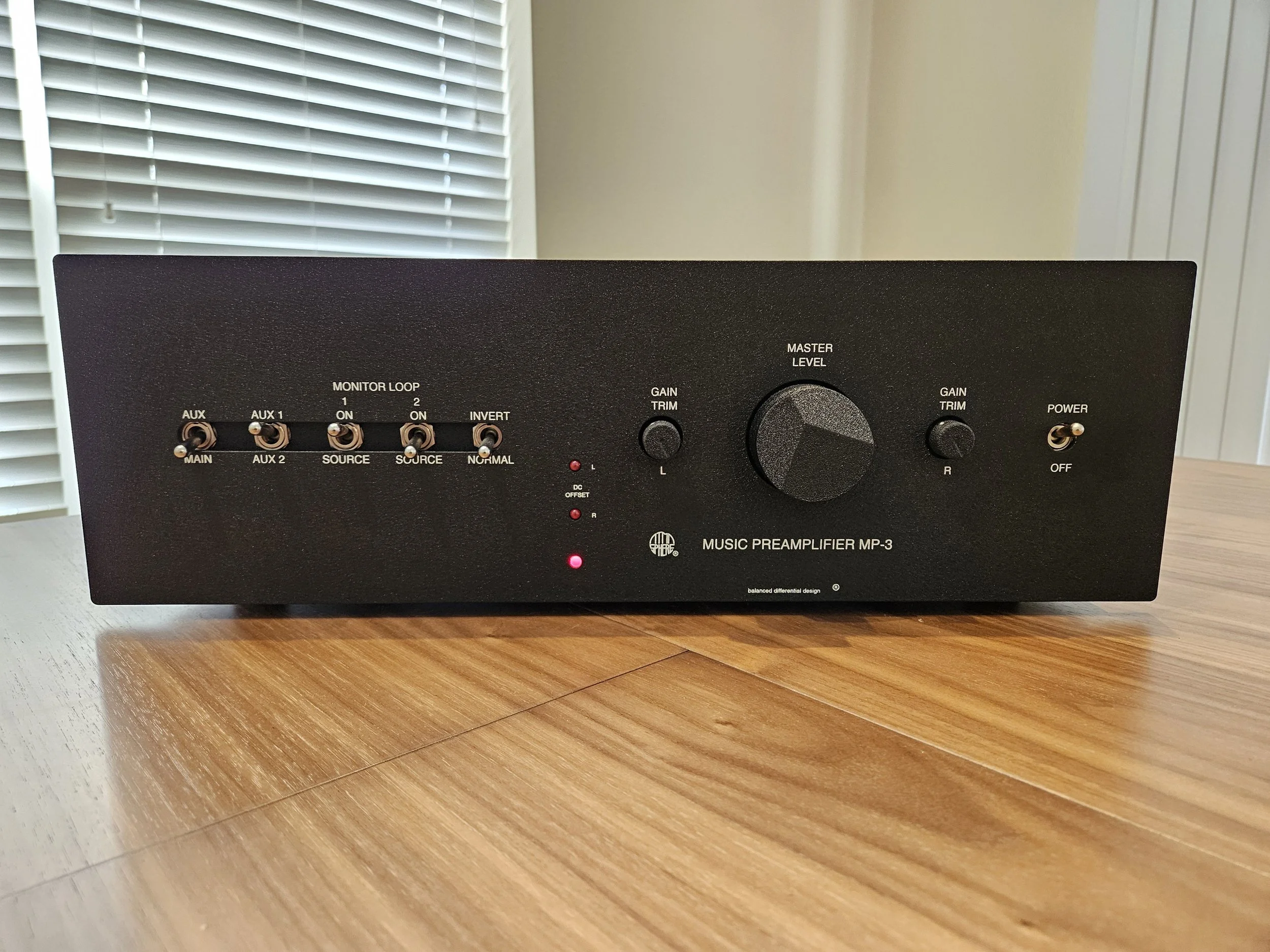
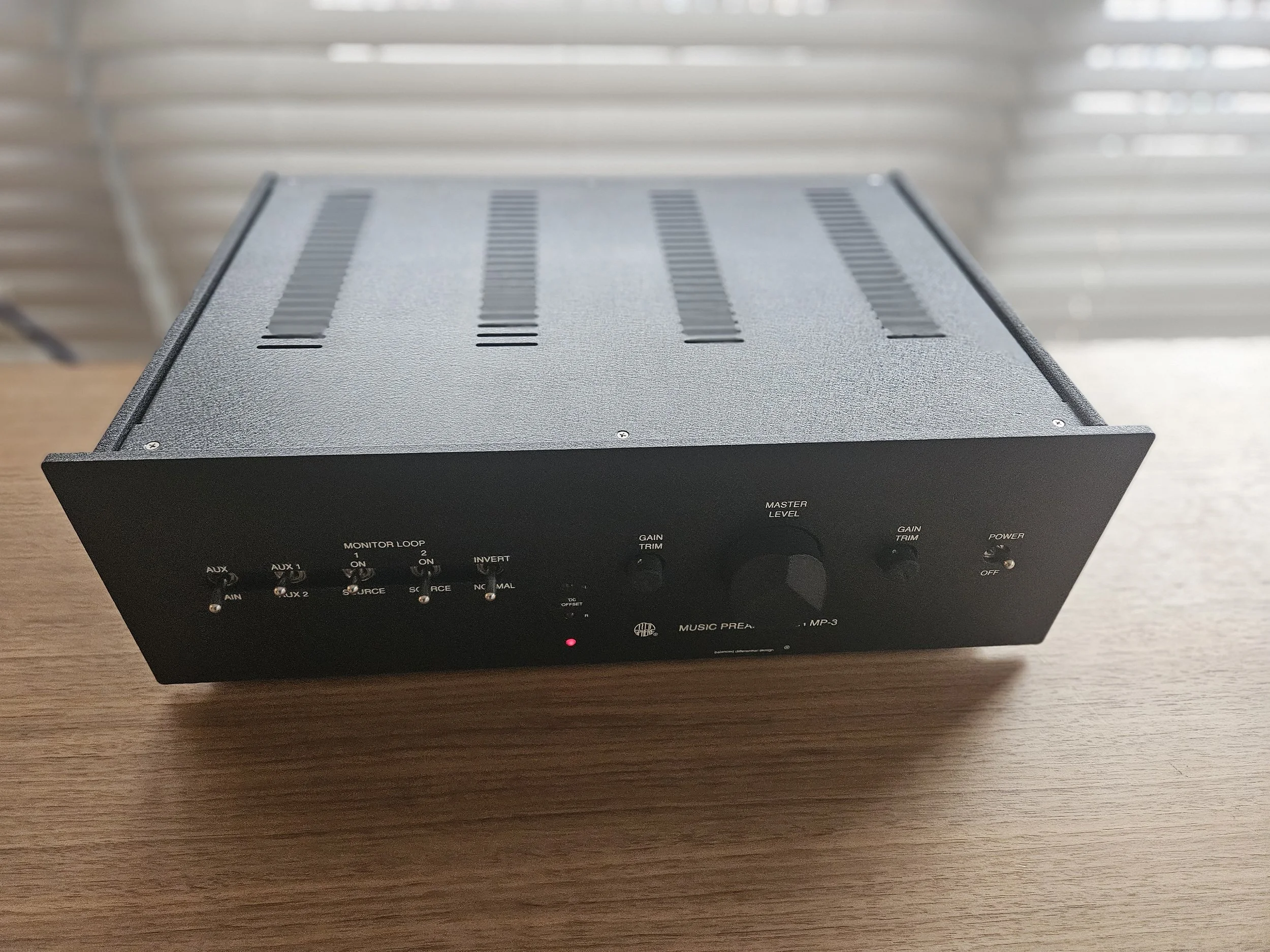
The Atma-Sphere MP-3 Preamplifier comes in a very straightforward rectangular, metal box, its patina is that of black ‘Wrinkletex’, which is supposedly very hardy and darn near scratch resistant. The MP-3 is fully tubed and incorporates seven 12AT7 tubes and two 12AU7 tubes, which lie inside the MP-3’s chassis. Even its front panel controls are ‘old school’ represented by five toggle switches and three rotary knobs.
The Atma-Sphere CLASS D Monoblock Amplifiers
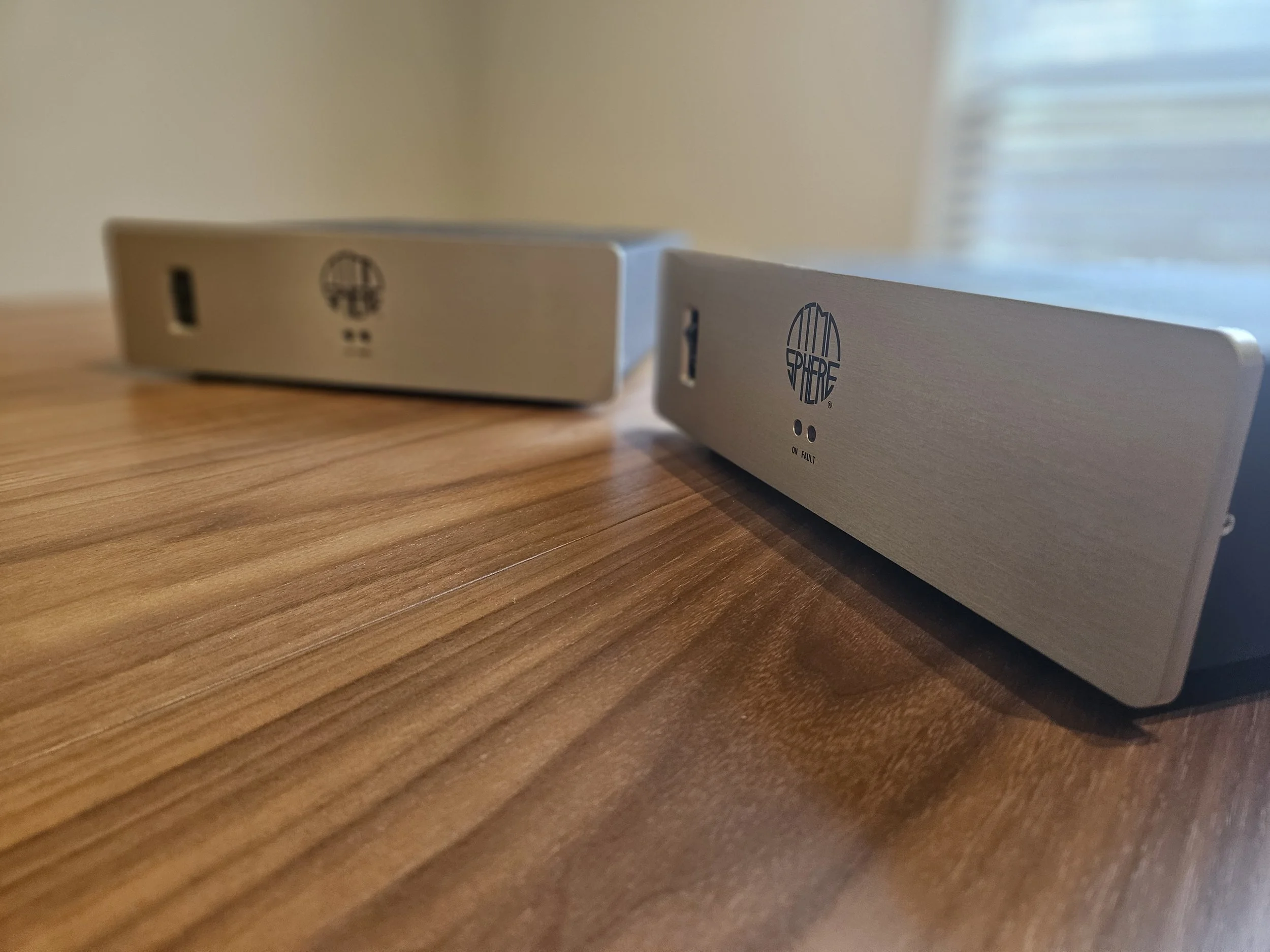
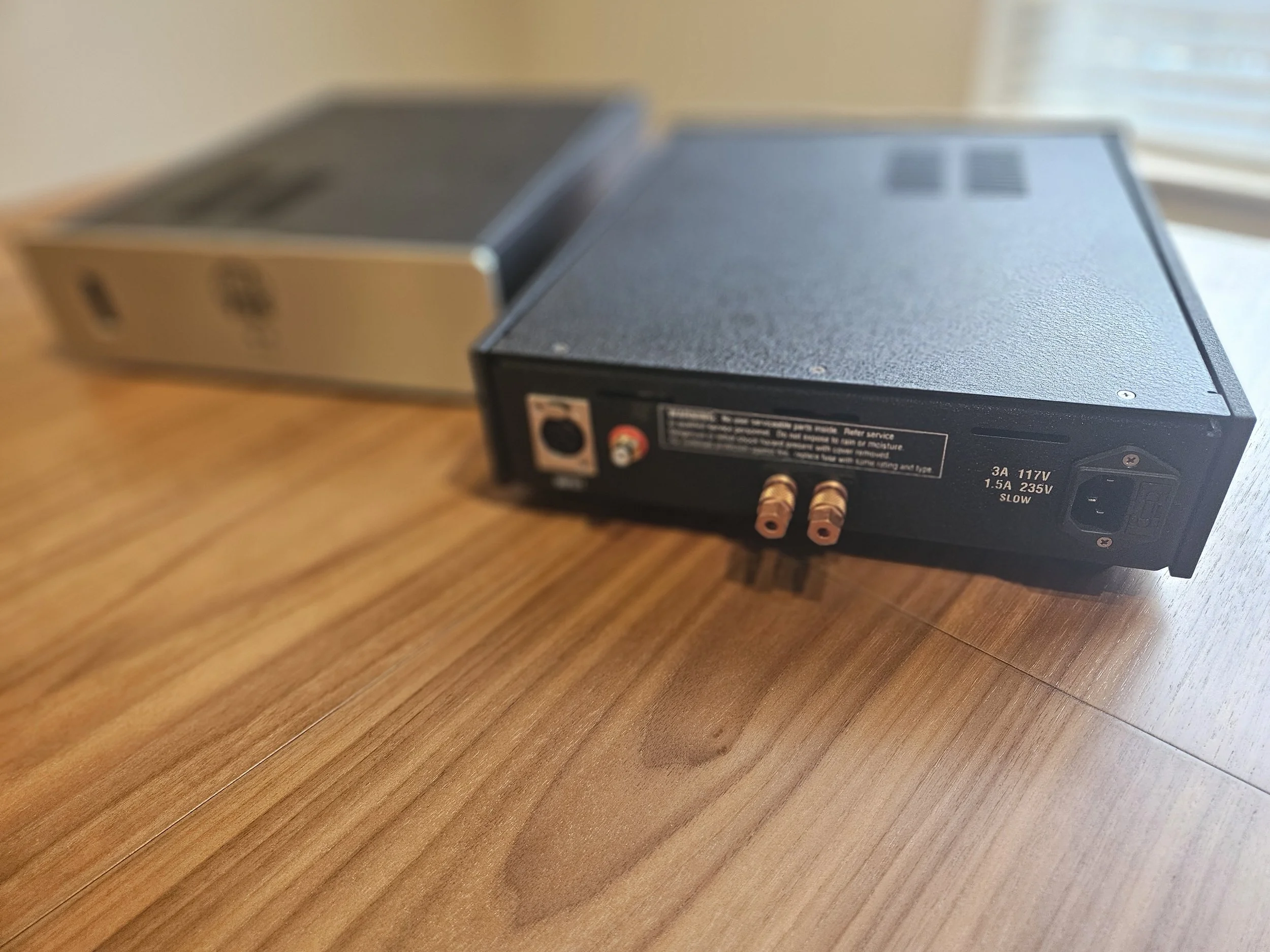
The Atma-Sphere CLASS D Monoblock Amplifiers couldn’t be more straightforward and, well, clean from a design perspective. They are ‘Wrinkletex’ colored rectangular, metal boxes with a champagne colored face. Their front face has at the far left an on/off switch and a red ‘on’ light at their centers. Their back face features an IEC socket at the far left, a set of Cardas speaker binding posts at center, and inputs for either balanced or single-ended connection at their far right.
While many may consider the Atma-Sphere combo ‘no thrills’, I find the MP-3 decidedly appealing in its ‘old-school’ way. The Class D monoblocks speak to the simplicity of sparsity.
Functionality
Atma-Sphere MP-3 Preamplifier
Front: As mentioned above, the Atma-Sphere MP-3 Preamplifier has five toggle switches and three rotary knobs. The toggle switches from left to right are for two auxiliary balanced inputs, two single-ended tape monitor inputs, and an inversion toggle. The front panel rotary controls from left to right feature a small diameter left-channel gain control knob, a larger diameter volume knob (centered), and a right-channel gain control knob. The smaller gain control knobs ‘trim’ the volume in the left or right channels to taste. The larger volume control knob is a “precision 23 position stepped volume control built with 96 resistors on a custom built switch”.
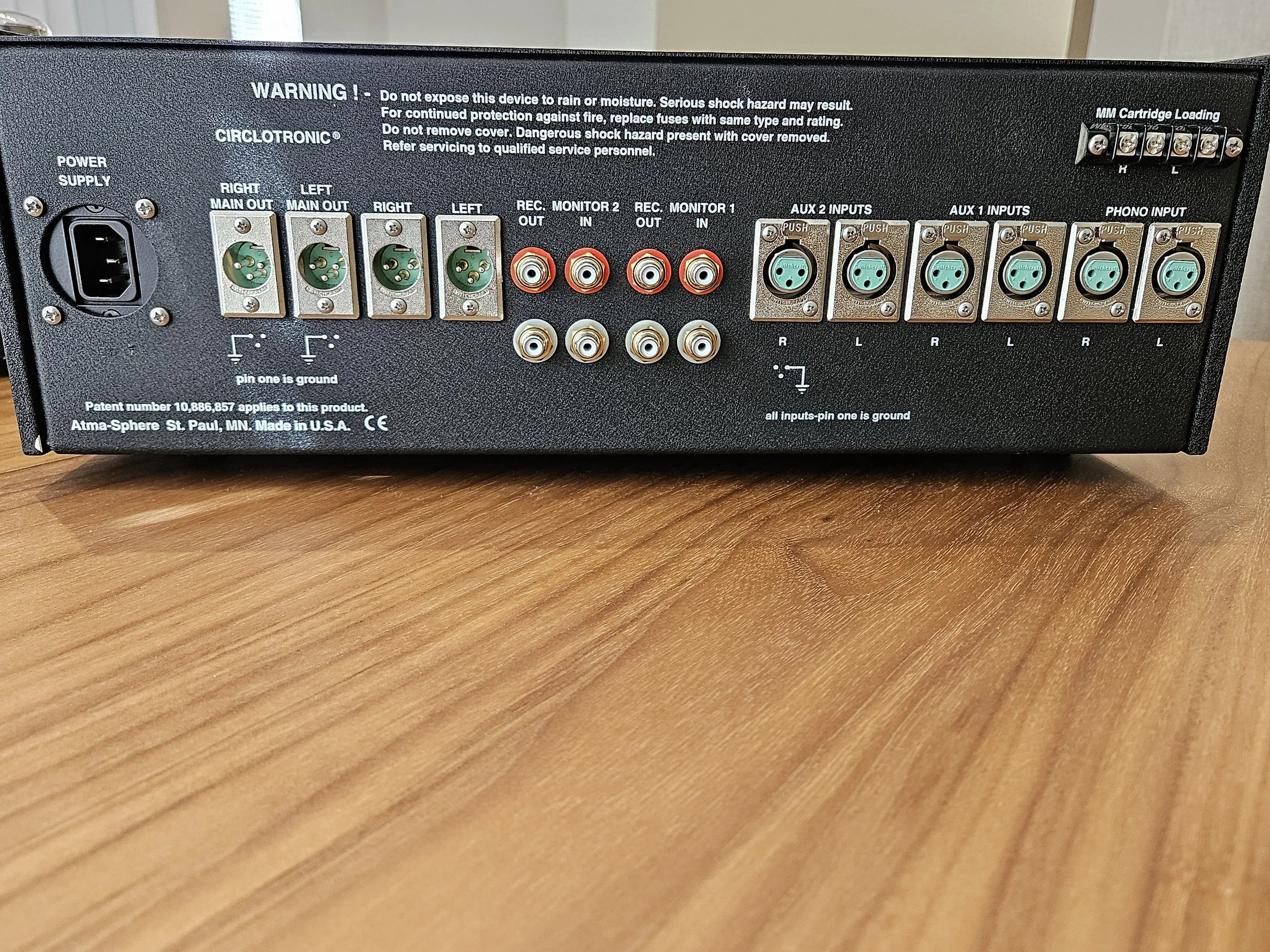
Back: The MP-3 features from left to right an IEC two balanced outputs. Next are four-sets of single-ended inputs for taping/monitoring that transform the signal-ended signal to a balanced signal internally. And at the far right are two balanced inputs, three if you have opted for the built-in phono-stage, which this MP-3 has and it is rightmost positioned.
The MP-3 is a fully Balanced Differential Design, which means it’s balanced through and through and doesn’t have, well, fake balanced inputs or outputs. Those for whom optimum quiet is essential or long cable runs, there is, perhaps, no better design. Ralph also mentioned that with this design, regardless of the balanced cable used or its cost, it will make little difference relative to the MP-3’s design (this also goes for the S-30).
The Atma-Sphere CLASS D Monoblock Amplifiers
Front. As mentioned above, the CLASS D’s front face has, at the far left, an on/off switch and a red ‘on’ light at their center. Done.
Back. Their back face features an IEC socket at the far left, a set of Cardas speaker binding posts at center, and inputs for either balanced or single-ended connection at their far right.
However, one should abide most carefully when powering up the Atma-Sphere MP-3 and CLASS Ds. The procedure should follow the input to output power up, that is powering on one’s system from source to preamplifier to amplifier.
The MP-3 has two offset light above the power light that come on initially and briefly to check left right amplification balance and then go off. Turning the amplifier on first and then the preamp will find those offset light searching, momentarily, for balance before the recede to off.
Note: You’ll need to give the Atma-Sphere Class D Monoblocks, at least, 450 hours before they sound their very best. They’ll be good before then, but not great.
Conclusions
The Atma-Sphere MP-3 Preamplifier and the Class D Monoblocks are a hybrid combination, a class above a good deal of the rest. They brought continual enjoyment to both working listening sessions and personal listening sessions and my attention was alway rapt. As reviewers know, after working listening sessions, one generally needs a break from listening altogether. This was not the case with the Atma-Sphere MP-3, Class D hybrid combo. I listened more with them than I had listened to music in a very long time.
Interestingly enough, this hybrid combo has bettered, hands down, any single-ended amplifier that I have reviewed to date. Ralph told me that it would. I didn’t believe him at the time and though I didn’t smirk, I’m sure I wanted to. Well, the secret was in the sauce of hearing this unlikely hybrid combo featuring a OTL preamplifier and a pair of Class D monoblocks. What’s the world coming to? Wonderful, technically superb music it would seem.
You guessed it: DIAMOND AWARD, hands down! And though the November Best of the Year 2024 issue has just passed, you will definitely be seeing this combo again in the 2025 awards issue. Bravo!
Pros: Superb technical abilities married to exceptional musicality and aliveness and engagement.
Cons: Not a single one.
The Specifications
Atma-Sphere MP-3 Preamplifier
Line stage input impedance: 100KΩ single-ended/200 KΩ balanced
Gain: 15 dB
Differential Inputs: 2 - Single-Ended RCA
Speaker Outputs: 0, 4, 8 Ohms/per side
Tube Compliment: 7 x 12AT7, 2 x 12AU7
Frequency Bandwidth: 1 Hz-200 KHz, +0 dB, -2dB
Phono stage input impedance: 47 K Ω, adjustable
Phono stage gain: 55 dB
Phono bandwidth: 0.5 Hz-90 KHz within ½ dB
Dimension & Weight: 13"x 17" x 5.5” (33 x 43 x 14 cm) 19 lbs (8.6 kg)
Atma-Sphere CLASS D Monoblock Amplifiers
Power Output: 100 watts per channel into 8 Ω 200 watts per channel into 4 Ω
Gain: 22dB (for 8 Ω)
Speaker Outputs: 0, 4, 8 Ohms/per side
Frequency Bandwidth: 1Hz-20KHz
Dimension & Weight: 13"x 11" x 3" (33 x 28 x 8 cm), 14 lbs (6.35 kg), per chassis
Warranty: Three year general coverage
The Company
ATMA-SPHERE
Atma-Sphere MP-3 Preamplifier (line stage only): $6,450
Atma-Sphere MP-3 Preamplifier (line stage & phono stage): $7,700
Atma-Sphere CLASS D Monoblock Amplifier: $6,120
www.atma-sphere.com
ralph@atma-sphere.com
Tel. : +1 651-690-2246