MUSIC REVIEW: ELLA AND LOUIS – Ella Fitzgerald and Louis Armstrong
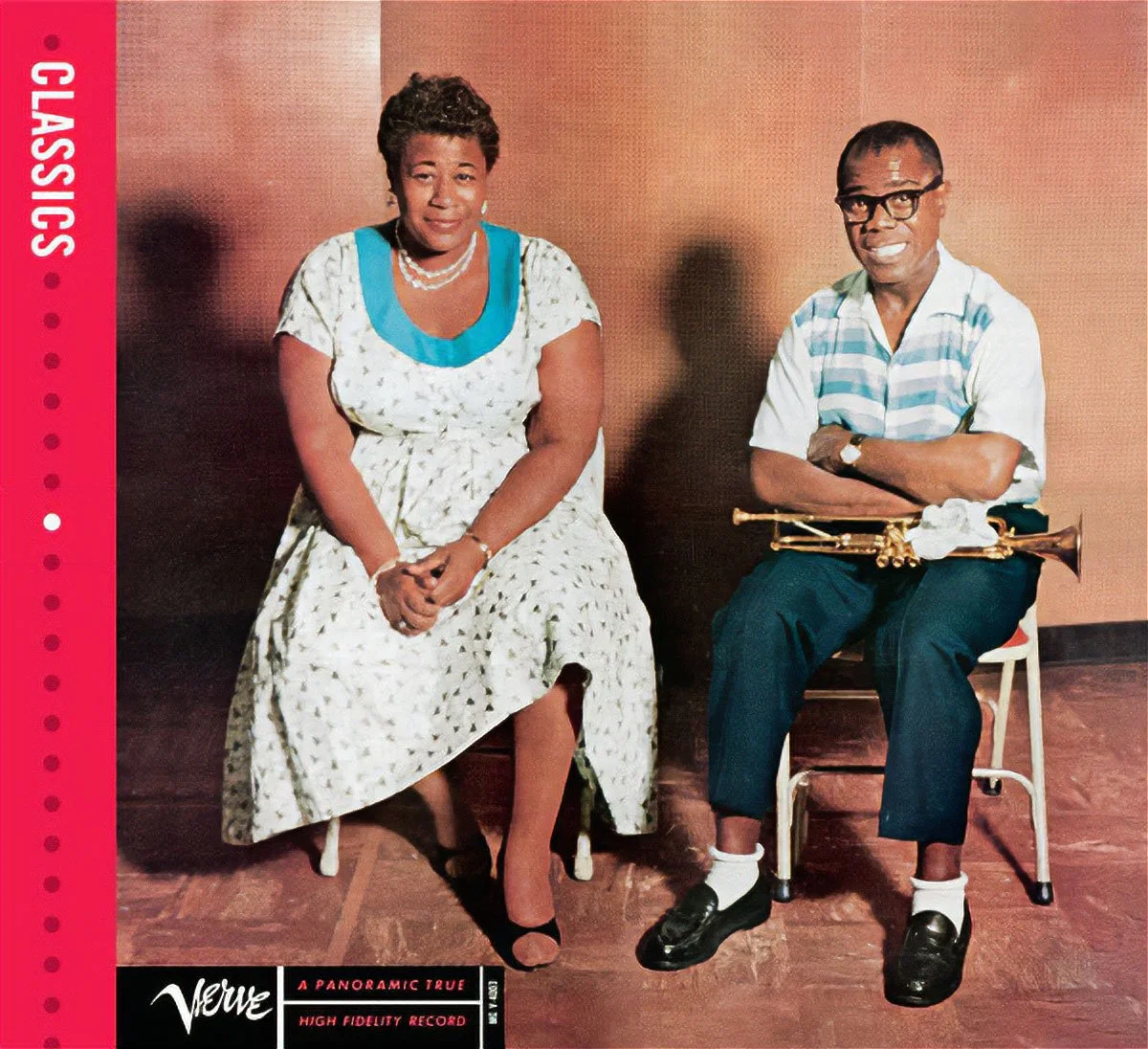
Like our esteemed Editor-in-Chief, I have formed the pleasurable habit of listening to a great deal of vocal music. Lately, that’s meant listening to two stellar twentieth-century artists whose recordings never seem to grow old: Ella Fitzgerald and Louis Armstrong. Their unmistakeable voices permeate my musical thinking—and yours too, no doubt. Both left impressive discographies, and they’re responsible for way too many of the ear worms that seem to flit across my mind at 3 a.m.
Armstrong and Fitzgerald both enjoyed decade-spanning careers, singing solo, with other artists, and later together. Both became international icons in multiple genres of jazz and popular music—big band, swing, Blues, bebop, traditional jazz, sultry ballads—you name it, they sang and played it.
Of course, they had great material to work with. The lyrics they interpreted, from the likes of Cole Porter, the Gershwins, Irving Berlin, and Rodgers and Hart, were, by turns, clever and tender, and set to unforgettable melodies (the aforementioned ear worms). For their part, Porter et al. were equally thrilled to write for artists of such a high calibre. As Ira Gershwin said, “I never knew how good our songs were until I heard Ella Fitzgerald sing them.”
Armstrong and Fitzgerald produced three official collaborations in the 1950s: Ella and Louis (1956), Ella and Louis Again (1957), and Porgy and Bess (1959).
Mid-century, racism continued to rear its ugly head for Black artists and ordinary citizens alike. Legal and de facto segregation in the United States and elsewhere meant that even the most famous Black artists had to stand up and challenge the status quo. In 1957, Armstrong famously criticized President Eisenhower over segregation, saying, “The way they are treating my people in the South, the government can go to hell.”
Sometimes white artists had to intercede. Marilyn Monroe promised to sit at a front table at the Mocambo club every night as long as Ella was booked there. Predictably, the press went wild, and the Mocambo gig proved to be a turning point in Ella’s career. Monroe and Fitzgerald remained friends until Marilyn’s untimely death.
Lady Ella spreads her wings
Ella had an unstable childhood, culminating in being sent to the New York State Training School for Girls at the age of 15, after her mother’s death. She was considered “ungovernable.” There was a school choir, but she did not belong because it was all-white. Luckily for music history, she was able to run away, and wound up as a street urchin in Harlem. She originally wanted to be a dancer, but all that changed when she took to the celebrated stage of the Apollo Theater in New York to sing. Within a year or two, she was getting regular gigs with Chick Webb and his Orchestra.
Ella’s first recording, Love and Kisses, was released on Decca in 1936. Two years later, she recorded A-Tisket, A-Tasket, which sold a million copies, hit number one, and spent 17 weeks on the charts. Twenty-one-year-old Ella Fitzgerald had arrived.
Among many other albums, Fitzgerald recorded a seminal 19-volume series of songbooks. She attracted attention for her impeccable diction, vocal intonation, and her uncanny ability to improvise, especially in her scat singing. Fun fact: Fitzgerald (along with Lena Horne) was considered for the role of the café entertainer in Casablanca. (The role eventually went to Dooley Wilson, who sang As Time Goes By.)
Ella continued to perform and record tirelessly even after her health declined. She had a quintuple bypass in 1986, and eventually, serious circulation problems led to the amputation of both legs below the knee. After her death in Beverly Hills in 1996, the traffic was stopped to let her cortege pass through. Outside the Hollywood Bowl Theater, the marquee read, “Ella, we will miss you.”
Satchmo and his legendary lips
Born in New Orleans in 1901, Armstrong was raised by his mother in a dodgy neighbourhood and had to drop out of school in fifth grade to go to work. Hired to do odd jobs for the Karnofsky family, he had his first break: they gave him the money to buy his first instrument, a cornet, for the princely sum of $5. (He only started playing the trumpet in 1926.)
Like Ella, Louis served some time in “juvie.” Sent to the Colored Waifs’ Home for Boys when he was 11, he perfected his playing on the cornet and set his heart on becoming a professional musician once he was sprung from the home. Joe “King” Oliver took the promising kid under his wing and the two started playing and making records together in 1923. Louis’ second wife, Lil Hardin, the pianist in Oliver’s band, encouraged him to form his own band.
Soon he was making recordings under his own name, and his back-up band, the Hot Five (later the Hot Seven), made records that highlighted Armstrong’s improvisation on the trumpet and scat singing. His recordings were influential, turning jazz from a genre based on ensemble playing to a showcase for talented soloists.
He began touring in the 1930s and continued for the rest of his life, at great cost to his health. He suffered from painful scar tissue on his “chops”—the famous Satchmo lips—from playing the trumpet with great force.
The 1950s and ‘60s saw Armstrong touring Africa as an official cultural diplomat for the U.S.A. The State Department-sponsored program was designed to improve America’s image overseas by sending jazz musicians and other entertainers on goodwill tours.
He even managed to beat the Beatles. In late 1963, Armstrong and his All Stars recorded a little ditty called Hello, Dolly! for a Broadway musical by the same name. The song knocked two Beatles songs off the top of the charts at the height of Beatlemania and made Armstrong the oldest musician in American history to have a number one song.
Perhaps his most beloved song was What a Wonderful World, released in 1967, which became a number one hit around the world. Touring had taken its toll on his health, however. He died in his sleep in Queens, New York, on July 6, 1971. His house is now the site of the Louis Armstrong Museum.
Discographies
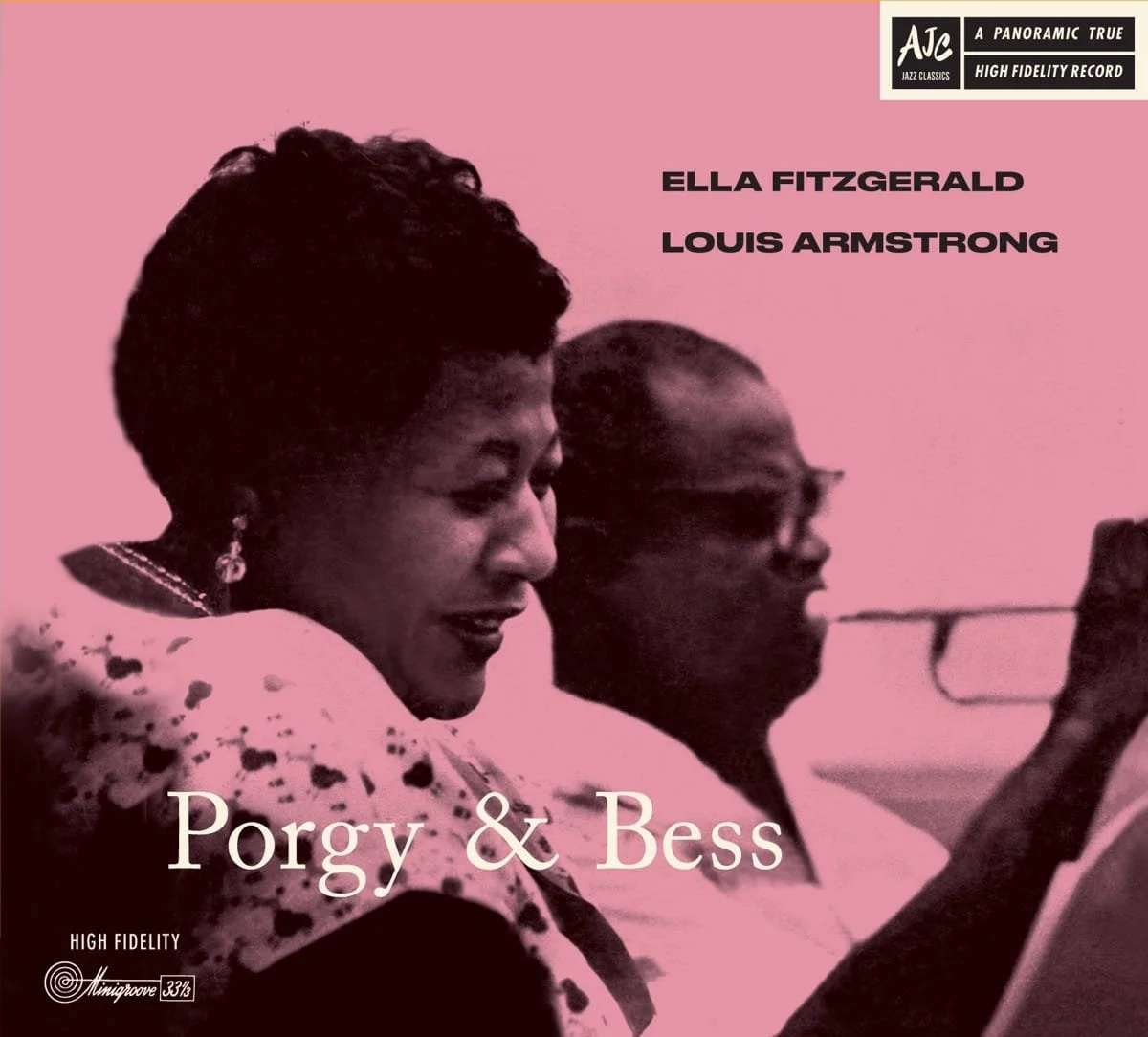
If you were hoping I’d recommend a short list of “must-listen” albums, I’m sorry to disappoint you. Any attempt at such a list would occupy this entire issue. Consulting the usual suspects online will bring up many tracks for your listening pleasure.
I will say, however, that while researching this article, there were a few songs I played over and over again:
Autumn in New York
A Fine Romance
Let’s Call the Whole Thing Off
I Loves You, Porgy
A Foggy Day
They Can’t Take That Away from Me
Over to you…