MUSIC REVIEW: SIMON PIERRE BESTION – BACH MINIMALISTE
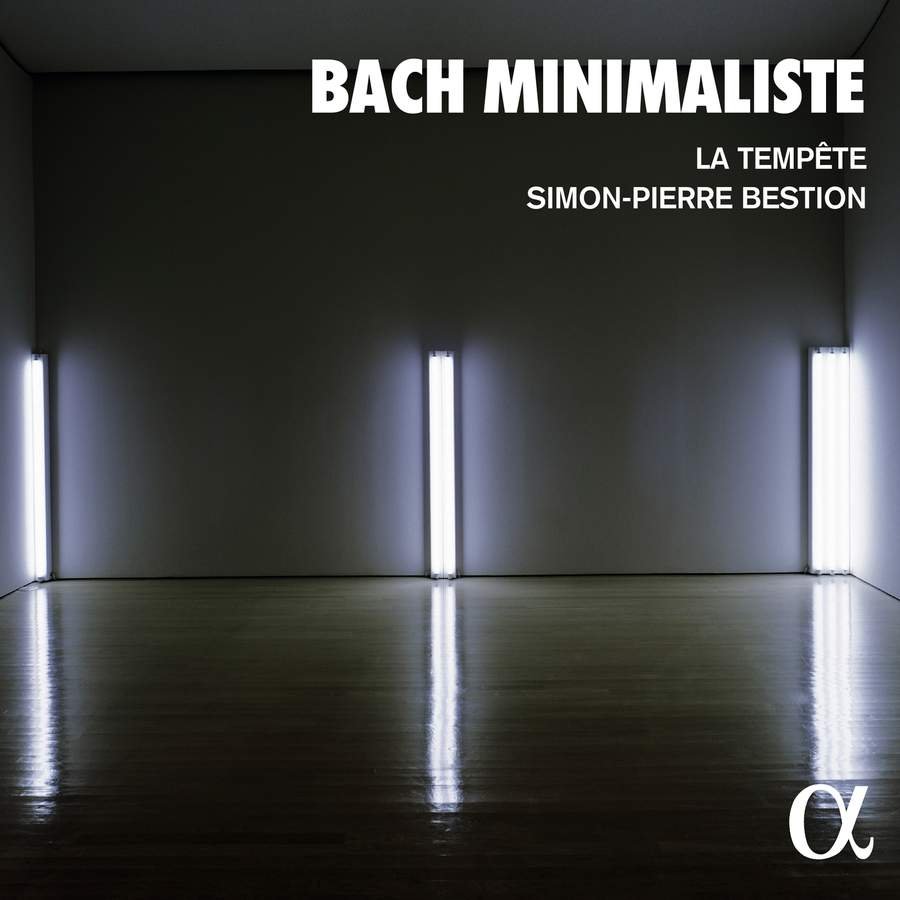
Every extreme inevitably breeds its opposite. In a world of increasingly overwhelming complexity minimalism is looming large on the other end of the spectrum. Minimalist music for meditation, for innerness, for immersion. for reaching out to simplicity from out of the midst of all the complexity. So a title like Bach minimaliste is immediately appealing. However, don’t be fooled by the title. What the ensemble orchestra La Tempête under the direction of Simon-Pierre Bestion is trying to achieve is a demonstration of the continuity between J.S. Bach and the minimalist contemporary composers of the late twentieth century with their return to simpler harmonies, repeating loops and patterns, use of drones, and pulsating steady rhythms, while eschewing the harmonic and rhythmic complexities of earlier twentieth century serialist composers. Techno music and electronic house are analogous examples in a different genre. Philip Glass is probably the most famous and influential of this minimalist group with his hypnotically repeating ostinato patterns and simple harmonies. Others include Terry Riley, Steve Reich, John Adams and Arvo Pärt to name a few. Featured on this album, alongside Bach, are Henryk Mikolaj Górecki (1933-2010), Knut Nystedt (1915-2014), John Adams (1947), and Jehan Alain (1911-1940). Bach minimaliste is also actually an ongoing audio visual collaboration begun in 2019 in which stage design and video mapping are supposed to enhance the patterns and repetitions in the music.
The patterning of the album itself is an interesting one. Works loop in and out, and the structure of the whole is distinctly non-linear. The first movement of Bach’s Harpsichord Concerto No.1 in D minor is followed by the first movement of Górecki’s Concerto for Harpsichord and String Orchestra (also in D minor), followed by Knut Nystedt’s Immortal Bach op.153b (based on the first line of Bach’s sacred song “Komm, süßer Tod”), followed by the first movement of John Adams’ Shaker Loops. Movements from these works all reappear later in the album, looping in and out of the track list. The only works to not recur are Jehan Alain’s Litanies , Bach’s Passacaglia in C minor and the concluding chorale prelude fragment, “Vor Deinen Thron tret ich”. A way of emphasizing the similarities and continuities between the works I guess, along with the whole idea of loops and patterns.
The opening movement of Bach’s Harpsichord Concerto brims with energy and Bach’s particular type of complexity, harmonic and structural. The driving force of the ensemble’s playing is palpable here, as is that of harpsichordist Louis-Noël Bestion de Camboulas who is technically and musically assured throughout the album, whether playing the leading soloist role, providing a rhythmic ostinato accompaniment or erupting into cadenza-like displays. As always in Bach, dissonances get resolved rapidly into harmonies and maybe that was the crucial difference between then and now: the belief that dissonances in music (or in our lives) would not be left hanging but would always find a resolution into harmony.
There is a well nigh seamless transition into the first movement of Górecki’s Concerto for Harpsichord and String Orchestra – these transitions are themselves a feature of the album, again in an effort to show the continuity in tradition from the High Baroque to contemporary minimalism. I even had to stop and check whether Bach might not have wandered into unfamiliar territory! But no. Here the harpsichord plays more the role of an ostinato rhythmic accompaniment with the strings providing a legato foregrounded melodic line imbued with a sense of menace and tragedy missing in Bach. The dissonances between harpsichord and the strings’ motif grow more palpable, more troubling, to be ultimately resolved by a very long very drawn out chord held into a pianissimo. Who says instrumental music cannot ‘speak’?
Norwegian composer Knut Nystedt derived his Immortal Bach for an a cappella mixed choir from the first line of Bach’s “Komm, süßer Tod”. Slow moving and profound, Nystedt transforms Bach’s song for one singer and basso continuo into an arrangement in which the singers, while starting and ending any phrase together, perform it at varying tempi. The result, even in these extracts bookended by other works, is nothing short of mesmerizing with a quality of timelessness.
Shaker Loops by John Adams furnishes the next contrast – we get to hear all four movements, starting with “Shaking and Trembling”, but we have to wait till after Alain’s Litanies for “Hymning Slews”, and more Bach, Nystedt and Górecki before we get to III (“Loops and Verses”) and IV (“A Final Shaking”). These, somewhat unusually for the album, follow on from each other, presumably being impossible to prise apart. Volume and intensity are again elevated in “Shaking and Trembling”, while the following Litanies by Alain are an altogether lighter affair, even jazzy at the start with filmic elements. This leads us into Adams’ “Hymning Slews” with its sense of quietude, the music aiming for a kind of quiet ecstasy. An arrangement for harpsichord and strings of Bach’s Passacaglia follows, showing once again just how well Bach’s music adapts to different mediums. This arrangement brings out the lines and texture of the original with great clarity and accentuates the timeless nature of Bach’s music. The transition into the reprise of the muted tones of Nystedt’s Immortal Bach is seamless. The wall of vocal sound achieved here reminded me of Eastern Orthodox chant and is a highlight of the album.
The third movement of Bach’s Harpsichord Concerto comes as a huge contrast. It is classic Bach, brimming with driving energy and joie de vivre – a joyous listening experience with some brilliant work on the harpsichord. The transition into the second movement of the Górecki Concerto for Harpsichord did not work as well to my ears as the first transition, the Górecki sounding like an aural assault after the joyous positivity of Bach. The driving energy is present in both, but here it is mechanical, compulsively relentless, not to mention dissonant.
Adams’ final two movements from Shaker Loops seem to remind us of the compulsions of faith and of relentlessly building movement.
An arrangement for strings of Bach’s chorale prelude fragment “Vor Deinen Thron tret ich” follows, taking a little time to settle the listener into the music’s harmonious beauty and resolution of human concerns. And aptly bringing the album to its conclusion.
Bach somehow manages to combine and transcend both complexity and simplicity. Incorporate dissonances and resolve them in passing. Make use of patterns yet not sound repetitive. More Bach please! But all in all, an intriguing concept and an intriguing and rewarding album.