DVA DIGITAL PREAMPLIFIER - REVIEW
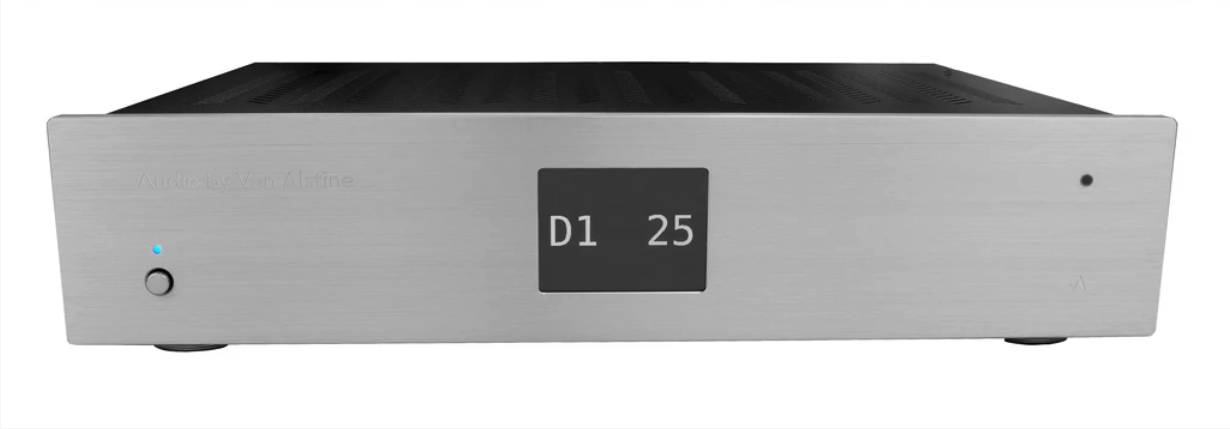
DVA DIGITAL PREAMPLIFIER
DACs are one of those components that span a wide range of functionality and price. Along with transducers, including loudspeakers and phono cartridges, they convert one form of information into another. As with speakers and carts, DACs tend to have a sonic character, one adhering to the philosophy of their manufacturer. Many cheap and cheerful designs tend to follow the quirky NOS or Non–Oversampling method which, unless realized by expert hands, carries a disappointing, high frequency veil. You may also notice the now–standard practice by Chinese manufacturers to use an “R2R” or ladder DAC coupled to tube amplification, which delivers “…the natural sound of analog audio,” as a recent press release from a Shenzhen manufacturer claims. What it actually delivers is higher, albeit “pleasant,” distortion along with reduced subjective bandwidth. Most DAC designers these days use the more modern multi–bit–with–oversampling approach which, when done well, not only offers the “natural” tone NOS vendors espouse, but also delivers the midrange detail and high frequency air inherently carried by a high resolution data stream. R2R designs simply ignore this detail and air.
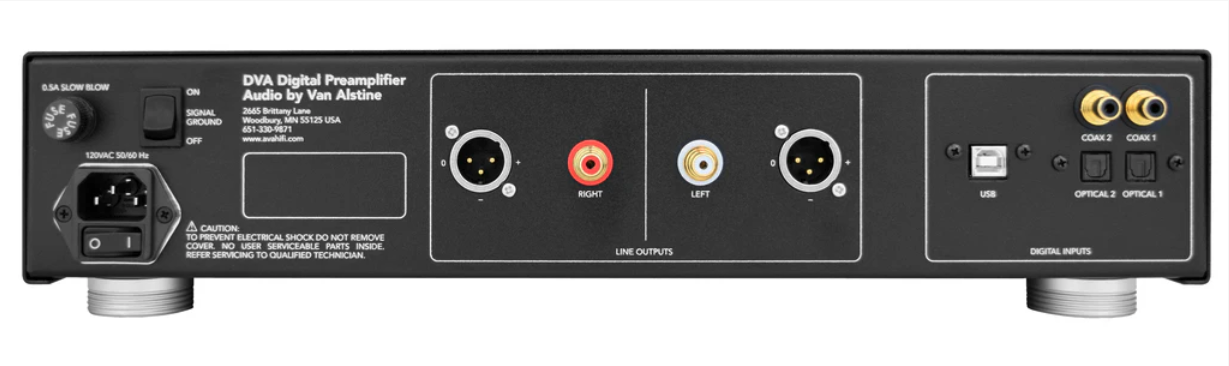
Audio By Van Alstine’s DVA Digital Preamplifier is one such converter that relies on the latest oversampling chip set. Mithat Konar, the electronics design wizard at “AVA,” chose for his converter approach what many consider to be the premium supplier, Asahi Kasei Microdevices or AKM. The result is a beefy hardware piece that delivers velvety finesse without the stridency found in similarly priced offerings that emphasize looks over performance.
At $2199, the DVA Digital Pre sits one price slot up from worthy entry level offerings by WiiM, Geshelli and Merason. Above $1.2k, the performance usually begins to widen relative to the lowest cost DACs, along with features I consider important like true balanced outs, support for DSD and DXD, and well–implemented resident software that emphasizes ease of use. The DVA includes all those niceties, along with a low noise, internal power supply. The DVA Digital Pre is what one these days would consider a “pure” DAC; no streaming, no required companion app, no upsampling to make the poor quality anti–image filters sound “better,” and no soft VU meters gracing the front panel. Indeed, the front panel is spartan by today’s standards; a touch–sensitive display and a take–me–out–of–standby button. Even though its name suggests a traditional preamplifier, it is not that either. It does have a gain control, but no phono or analog inputs for that matter. If you do want to digitize a couple of analog sources, AVA will gladly sell you their $379 DVA A2D analog–to–digital converter. It has an AES3 coax output perfect for feeding one of the four AES ins on the DVA Digital Pre. If you don’t need analog ins for your system, then mazel tov! You’ve saved four hundred dollars!
Regarding that display, it was the only complaint I had, and a niggling one at that…The unit indicates the currently selected input in letters large enough to read across the room. Below that, in much smaller type, is the current sample rate. I would have liked to be able to reverse that order, with the sample rate prominently displayed and, once it’s been selected, the current input choice tucked away below.
Upon extended listening, what struck me was the similarities of sonic signature between some high end DACs I’ve heard over the years. Granted, aural memory is notoriously poor, and I acknowledge that. I’m simply saying that I found the DVA Digital Pre sound quite reminiscent of spendy beasts. The Mojo Mystique Y that I had last year for an extended time possessed a refined version that extra relaxed R2R sound signature. So too does the DVA Digital Pre. It was giving a elegant, almost silky aspect belying the fact that it cost about the same as many other DACs, yet avoids the harshness often found in poorly drawn and implemented multi–bit designs in its just over two thousand dollar price range. Need I remind you that low cost R2R DACs often perform poorly, while R2R DACs that perform reasonably well tend to cost far more than delta-sigma DACs that perform at an equivalent or higher level. At even $7k or more, ladder DACs tend to lack the ability to deliver the snap and excellent transient response that oversampling DACs, including el cheapo ones, handily provide. For all it’s past missteps, MQA is the exemplar for transient precision with its temporal correction feature. There is a whole wealth of high frequency detail hidden in a well–recorded HRA bitstream, and most all R2R designs conveniently sidestep that. Do note that the DVA Digital Pre does not support MQA, which is fine by me from the aforementioned purity standpoint.
To compare gear in real time is the only way I know to ascertain a new piece’s level of performance. Measurements and specs tell you a lot but have no bearing on the subtle differentiations our ear/brain combo is capable of. Toward that end, I level–matched my trusty but elderly exaSound e22 Mk. II to the DVA Digital Pre, streaming both from Amarra Luxe. The exaSound was powered by UpTone Audio’s linear JS-2 PSU while the DVA used the stock power cable included in the box. In turn the DACs directly fed my powerful and resolving Parasound JC5. Speakers were the stately, low distortion Triangle Signature Deltas via Audio Art Cables’ Statement series. By the way, a simple plastic remote is also included in the stout packaging, along with a welcome three year warranty.

So as to get a handle on the mid and high frequency differences, as well as texture which speak of a DAC’s temporal capabilities, I turned to conductor and viola da gamba player Philippe Pierlot’s Extasis [Qobuz 192k flora 2025]. On Extasis’ fourth track, Obras de musica para tecla, arpa y vihuela: No. 78, Diferencias sobre “La Gallarda Milanesa”, the listener is gifted with a mid–venue seat. In an unidentified Spanish space, the four viola seem to be arrayed in a 100° arc with the harp a bit back and stage left. Through the exaSound, the sound was naturalistic; the strings had the appropriate bite, the upper bass bloomed, and the placement of each instrument was clear–cut. Equally engaging but different, the DVA subjectively brought my seating closer by about six feet, with more midrange emphasis. While the string textures were a touch less convincing (well recorded bowed strings are, for me, a true test), the instrument placement was even more precise, and the bottom octaves were more pronounced.

Snarky Puppy & Metropole Orkest’s subtly live opening track, Waves Upon Waves [Qobuz 96k GroundUP Music LLC 2025] from their latest Somni, echos Jan Hammer with a biting processed violin solo (or was it a synthesizer?!). It isn’t until the end of the song that I realized it was recorded before an audience, in lovely Utrecht no less. This recording somehow condenses the sizable Orkest into a collection of synth patches. The strings sound canned, though the double percussion and solo instruments stood out as expected. Nonetheless, the whole far exceeded the sum of its parts. Can you tell I’m a Snarky fanboi? The exaSound painted a relaxed rendition, while the DVA again moved everything closer. This singular aspect of the DVA was so baffling, I had to check several times with pink noise that levels were, in fact, matched. In a word; BIG! The DVA Digital Pre had me in its technicolor grip, with the Hammeresque solo more “in your face.” Interestingly, during the breakdown at 5:09, the left channel slap echo from the horns stage left was less clear and distinct. This lessening of low amplitude detail relative to the exaSound was one of the only major subjective differences between the two units.

While progressing through the new releases collection at Qobuz, which I do as preparation for any review, I was excited to see a new title by Kenny Barron. In The Slow Lane from the recent Songbook [Qobuz 96k Artwork Records 2025] features Kurt Elling’s characterful vocals, with intimate backing support from Barron and his quartet. As expected from extended listening and comparisons, the DVA’s larger–than–life persona made for an enticing and immediate visit with close mic’d Elling et al. Indeed, Johnathan Blake’s stick work was as up–front as the vocal. Only the piano was subjectively set a bit back from the rest, and not by much. It’s a testament to the DVA’s slight brashness and exuberance that I often kept playing past track seven on to Cécile McLorin Salvant’s sparking vocal in the Latin–spiced Sunshower and beyond.
Ray Charles’ Don’t Set Me Free [Qobuz 48k Tangerine Records 2025] is a schmaltzy rave up engineered by none other than the legendary Bill Putnam. The mid–’60s recording is not the last word in fidelity, but there’s a lot of period production glitz gilding Ray’s and his Raelettes’ vocals. Wait, where’s Ray’s piano? Through either DAC, I couldn’t find it. Having had enough with the artsy fartsy classical and jazz along with rootsy R&B, I was curious to see if unabashed rock was what Doctor Feelgood was prescribing…Cue up a fave rock anthem, Journey’s Don’t Stop Believin’ [Qobuz 192k Columbia Legacy 1988]. I cranked it up and boom! That elusive refinement that is too often absent from similarly priced DACs, especially those that attempt to do more, transported me to another time and place. In my mind, I was sitting crosslegged in a weed smoke–filled meadow in San Francisco’s Golden Gate Park so long ago vibing to Journey! Many similarly–priced oversampling DACs exhibit a strident harshness, but the AVA shows none of that. It is at once punchy yet smooth, vivid yet cohesive, a study in how to design a converter that easily scratches the high fidelity itch without costing near as much as a set of high performance loudspeakers.
AVA’s DVA Digital Preamplifier is an excellent example of what current technology is capable of when applied to a thoughtful design. It combines some of the organic aspects of an R2R design with just a touch of the desirable detail that a ΔΣ (delta-sigma) oversampling architecture brings to the party. It certainly fulfills what designer Konar says was intended to be “…a music recovery box rather than as a platform for experimenters to satisfy their curiosities. It’s designed to deliver the best performance for people who listen to music, full stop.” If you’re dissatisfied with the artificiality of your current entry level converter, and are searching for the next step up in your digital audio journey, then I highly recommend find a way to listen to Audio By Van Alstine’s offering. It’ll clean up your repro chain and rocket you to another level!
THE COMPANY
Audio By Van Alstine
Maplewood MN
https://www.avahifi.com
DVA Digital Preamplifier — $2199 pair