MUSIC REVIEW: Víkingur Ólafsson – from afar
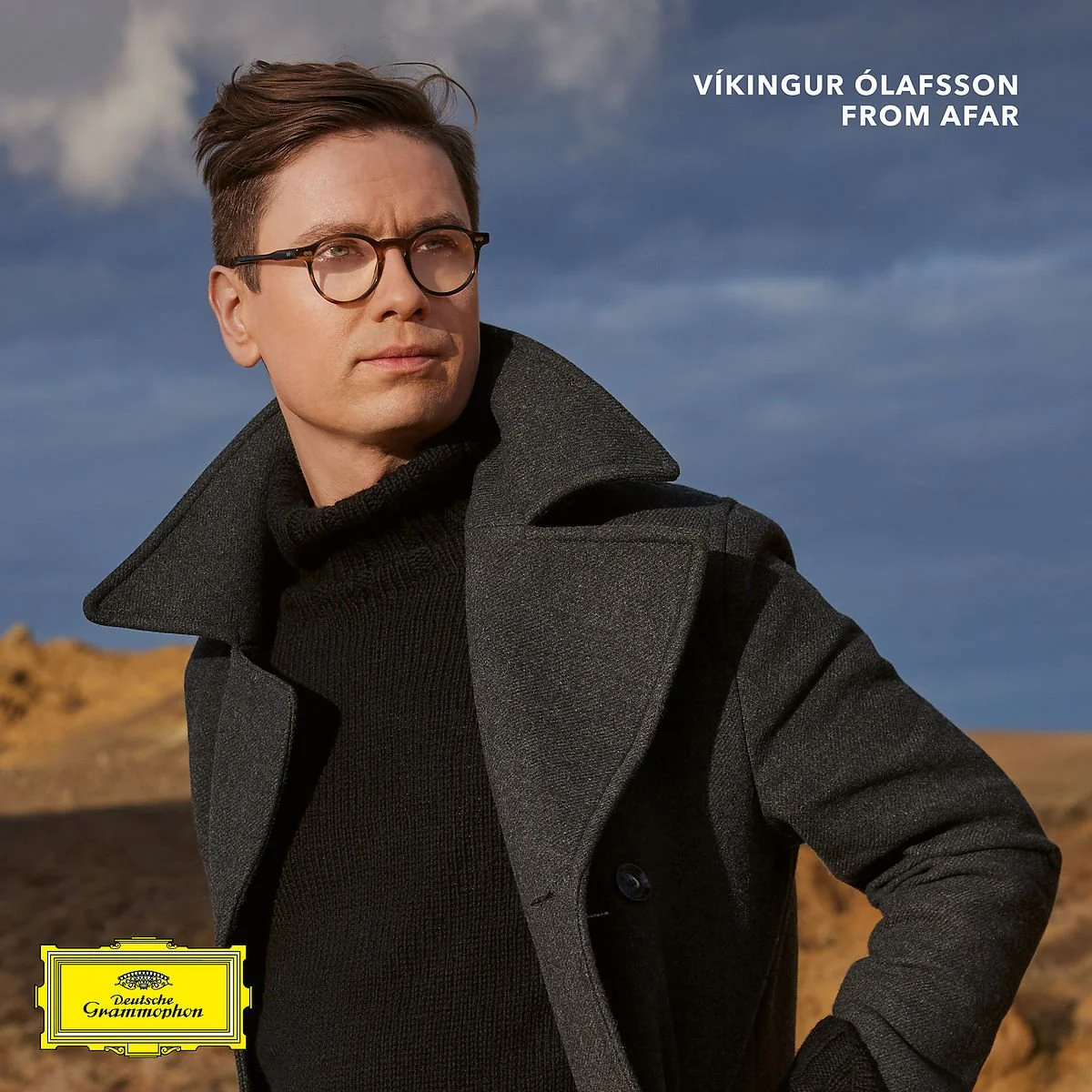
For this review I thought I would turn to my own instrument, the piano, and a recently released double album by Víkingur Ólafsson, an Icelandic pianist who has been hailed as the “new superstar of classical piano” (Daily Telegraph). He describes this release, From Afar, as his most personal yet, and it is easy to see why. The repertoire chosen ranges from pieces connected to his childhood to the enigmatic miniatures of his musical hero, Hungarian composer and pianist, György Kurtág, whose piano pieces provide the leitmotif for the albums. Even the title, From Afar, is inspired by Kurtág’s Aus der Ferne. Ólafsson recounts his inspirational meeting with the 96 year old Kurtág at the Budapest Music Centre in September 2021. It had a profound impact on him, returning him to his musical roots and initiating a reset in his approach to music. In Ólafsson’s words, “Talking with him and playing for him genuinely gave me a different perspective on life and on music.” From Afar is both a tribute to Kurtág and a thank you.
The reason behind the double album is that Ólafsson recorded the programme on two different pianos, the first a grand piano, and the second an upright. This once again harkens back to his childhood when he would practise on two pianos, his parents’ grand and the upright in his bedroom. Having both owned and played on both uprights and grands, the whole concept is intriguing, for each instrument certainly opens up a different soundworld, the one more resonant with a greater palette of colours, the other more intimate, at times more muffled and more percussive. For pianists the appeal of such an exercise is obvious, but I imagine you could also have a lot of enjoyment as a non-pianist comparing and contrasting the grand and upright albums using hi-fi equipment, seeing what new nuances and details would be revealed. How does decay compare? Resonance? Colour of top and bottom registers? Depth? Sustaining pedal effects? Plenty to explore in the listening.
From Afar features arrangements of works by Bach and Mozart, as well as Schumann, Brahms, Hungarian and Icelandic folk songs by Bartók and Birgisson, a world premiere by Thomas Adès and a moving “Ave Maria” by Sigvaldi Kaldalóns, with seven piano miniatures by Kurtág from his Játékok (Games) serving as the underlying constant. Most of the pieces on the albums are short, and each sets the next off in a beautifully judged way so that a kind of conversation develops between them across time and across musical styles. Binding them all together, apart from the pianist’s intention, is his deep sense of “Innerlichkeit” or in wardness, a deep musicality and purity which does not play for virtuosic effect but gives a sense of constant rediscovery of the music. And the eclectic mix keeps your interest constant with unexpected juxtapositions which nevertheless somehow ‘work’.
The album opens with a transcription for piano of a work by Bach, this one originally for organ. It is the first of several transcriptions, which include another Bach organ work and solo violin sonata, and Mozart’s “Laudate Dominum”. These sorts of piano arrangements would have been very popular in pre-gramophone pre-recording days, when the only way you could recreate an orchestral performance for yourself, or an opera perhaps, or even chamber music, was through piano arrangements. Ólafsson proves this art form lives on and deserves rediscovery and renewed listening even in our recording rich times. In his hands the arrangements bring new insights to the music. Bach’s music has always lent itself particularly well to transposition to different instruments – there is a kind of universality about it that does not bind it to any one medium and these arrangements reinforce this. It is interesting to compare the Bach pieces on grand and upright pianos: on the upright you immediately hear more mechanical noises, the pedal creaking (creaking pedals tend to be a mainstay of older uprights!), the sense of the felt covered hammers hitting the strings, the pianist’s breathing – all are more pronounced. The sound is somewhat mellower and thinner at once, with less depth of colour and resonance – the Bach sounds somewhat more percussive for instance – but the soundworld has its own charm.
The arrangement of Mozart’s vocal solo, “Laudate Dominum”, is one of the highlights of the album for me for the sheer beauty of the music and of the playing. Particularly on the grand Ólafsson makes the vocal line sing, while on the upright the vocal line comes across as more pianistic.
The three Schumann pieces interspersed in the programme once again bear witness to a profound musicality. The pedal points are beautifully recreated for piano in the first of the Studien für den Pedalflügel (arr. for solo piano). I love the unevenness and the rubato of “Träumerei” – it helps one to rediscover this well known music afresh in all its subtle rhythms and colours. I have long thought that classical music was getting too enslaved to a metronome, and to speed and virtuosity at the expense of musicality and soul, and it is a relief to find myself being proven increasingly wrong of late. “Vogel als Prophet” again displays subtle musicality and a sense of sheer enjoyment of the music. The Schumann pieces transpose just fine to an upright, though the study has a decidedly more muffled sound: there is less articulation evident but a greater wash of colour.
The two Brahms Intermezzos from op.116 give another example of Ólafsson’s beautiful sense of rubato. He is able to bring out the inner soul of these pieces revealing inner landscapes with a freshness and a sense of renewed discovery of music some of us might be very familiar with. The decay of piano notes is very well captured on the recording, particularly of the grand, and very evident here. There is no heaviness to Ólafsson’s Brahms, more a whiff of melancholy. On the upright the Brahms is pianistic and intimate, if not as rich in tonal colours. And, it goes without saying, the sustaining pedal overall is not as sustaining as on the grand.
Bartók comes up at his most melodious and plaintively beautiful, with Ólafsson’s sensitive rubato picking up on an authentic folk element and whimsical feel so often missed in interpretation.
The Kurtág miniatures weave in and out of the album, following on seamlessly from Bach or Brahms or leading into Mozart or Schumann. Their soundworld and use of the colours of the piano is quite different, an exploration of different registers and mysterious soundscapes of note clusters and glissandi, some seemingly evocative of snow and ice in the best Debussyesque manner (think “Les pas dans la neige”), most exploring the far reaches of the piano and the sonorities of the damper pedal and of note decay. All intriguing and enigmatic and dense in content. Listening to them I think they must be a lot of fun to play and I am tempted to get a score. By the way, the first Kurtág piece comes up as a revelation on the upright, opening up a different soundworld to the grand. The top high register is drier and more percussive, something born out by the next Kurtág offering. The bell-like quality achieved in yet another Kurtág piece once again compensates for any loss of colours. The haunting quality remains intact though on the upright, even though you can hear more of the mechanical aspects of piano playing, including the fingers executing glissandi. All these extraneous noises become integral to the performance.
At the end Kurtág returns enigmatically to round the album out sotto voce, with decays and pedal playing a huge role.
In short, a soliloquy for piano rendered open for others to share in. And to see how seamlessly the whole fits together you will simply need to have a listen.