MUSIC REVIEW: EMILY D’ANGELO – ENARGEIA
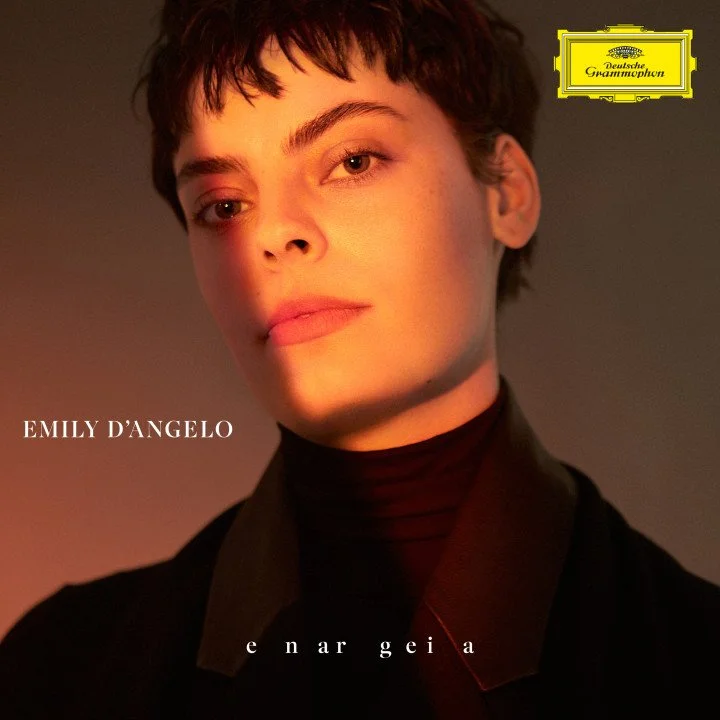
enargeia, released in October 2021, is the debut album of a stunning new arrival on the classical music scene, Italian-Canadian mezzo soprano Emily D’Angelo, who has just been signed as an exclusive artist with the prestigious Deutsche Grammophon label. Only 26 years old, she is already the winner of multiple opera awards with an enviable career, and from the moment her evocative mezzo voice enters on the first track it is easy to see the reason behind the accolades.
The title, chosen by the artist, comes from Ancient Greek rhetoric and refers to a way of recreating something by using words so vividly, that it “ seems to conjure its subject into existence”, as D’Angelo puts it. enargeia signifies both the arousal of emotion and aesthetic pleasure, and attests to the truth of what is being conveyed. Quite a tall order, but one that this album certainly approaches, as D’Angelo’s gorgeous rich mezzo weaves in and out of textures both modern and medieval, with exemplary control over legato and dynamics throughout her range.
enargeia features music by four female composers, from the 12th century Hildegard of Bingen to 21st century Icelandic composer Oscar-winning Hildur Guðnadóttir, and Americans Missy Mazzoli and Sarah Kirkland Snider. As D’Angelo states, Hildegard’s influence runs through this album like a thread. Certainly, there is a spiritual quality to most of the tracks, as well as the melding of a haunting medieval feel with a contemporary classical idiom unafraid of fusing electronics with acoustic instruments. Also highlighted is the interesting relationship, even affinity of sorts, between ancient plainchant and modern melismatic vocal lines set against drones and ostinato, with both displaying a certain rhythmic and harmonic freedom which grows organically out of following the text. The acknowledgement of Hildegard’s overarching influence on the music in enargeia is most appropriate, given that Hildegard herself was at the fountainhead of the Western classical tradition.
enargeia opens with a haunting track by Hildur Guðnadóttir, Fólk faer andlit. This is music with deep roots in a Nordic past which seems to grow into our present. Guðnadóttir uses a style related to plainchant over a drone, with instruments (strings and woodwind) weaving in and out of the texture and cushioning the voice. Two other stand out tracks immediately come to mind, both settings of Hildegard, one by Mazzoli, O frondens virga, in which violoncello and voice perform an ongoing duet, and the other by Snider, O virtu sapientiae, for voice and string quartet, encasing medieval chant in a contemporary ambience. I could listen to a whole album of such settings of Hildegard and not tire of them. The combination of old and contemporary makes for a timelessness that is very appealing. Personally, I love hearing this kind of chant performed by a female voice rich in colour and expressivity, and unafraid to use vibrato.
Hildur Guðnadóttir’s Lidur is another track that seems to grow out of Nordic landscapes as the singer duets with herself with haunting electronic delay effects. Like the opening track, Fólk faerandlit, this encompasses both folk roots and contemporary idioms, with the use of the lower strings adding a special feel to the vocal lines above.
Continuing the spirituality theme, Missy Mazzoli’s own work is represented by Hello Lord, from her “Vespers for a New Dark Age,” and by selections from her chamber opera based on the life of the Sufi Isabelle Eberhardt, “Song from the Uproar.” Snider is represented by selections from her song cycle “Penelope,” and a song from Caritas.
Each of the composers has her own distinctive style. While Guðnadóttir’s works share a particular evocative Nordic quality, Mazzoli creates fusions of electronica and strings, spilling over into more experimental atmospheric tracks such as A Thousand Tongues, or returning to the haunting lower strings and voice interplay with underlying pizzicato building tension in You are the Dust. Mazzoli’s Hello Lord begins as though it might grow into a spiritual, only to flower into a contemporary dramatic operatic number, a style also employed in the extracts from her chamber opera, and one which displays D’Angelo’s dramatic gifts and high register.
The selections from Snider’s “Penelope” are in a different style again and predominantly use a lower part of D’Angelo’s range showing off her range of colour and timbre. The settings here are more in the style of musicals, introducing elements such as drum kits and electric guitars mixed into a contemporary dissonant style. While Snider uses fuller orchestration, she also does not shy away from using the naked voice in the lower register in The Lotus Eaters or Dead Friend, the violent dissonances of which come as a shock when juxtaposed to the focused intense calm of Hildegard. It is interesting to hear so many classical vocal settings in English, a language which is notoriously difficult to set in the classical idiom, with some saying nobody has yet equalled Purcell in this regard. The tracks here do come pretty close though, I would say, helped by D’Angelo’s excellent enunciation.
While not all the tracks in enargeia would necessarily be my favourites, all are interesting to explore and each is expressively brought to life by D’Angelo’s gorgeous voice. Jarkko Riihimäki, who conducts Das freie Orchester Berlin, was responsible for many of the arrangements on this album and he has clearly done a superlative job.
This is an album to savour both for the artistry of Emily D’Angelo, and for its exploration of 21st century classical vocal repertoire by three women composers, but also, particularly, for its meditative beauty and its ability to look forward and back at the same time. The Hildegard arrangements alone would make enargeia worth having.